
Most travellers who have visited Pakistan will tell you that it is one of the most misunderstood countries in the world. It is home to a vast array of cultures and landscapes and some of the most friendly and hospitable people that we have ever encountered. We were blown away by what it had to offer, and we only really scratched the surface. Check out my Pakistan travel experiences below.
Lahore, Islamabad, Skardu, Gilgit, Karimabad
The modern nation of Pakistan was created as a result of the Partition of India in 1947, in which the territory of British India was separated along religious lines. Muhammad Ali Jinnah, known locally as Quaid-e-Azam (“great leader”), is considered the father of the nation in Pakistan. As the leader of the All-India Muslim League in the early 20th century, he was a major player in pushing for the partition of India and the creation of a separate Muslim state. He believed that if India remained as one large country, then Muslims would never be able to have a meaningful say in the government as a religious minority in a Hindu majority country. Sadly, like his Indian counterpart Mahatma Gandhi, Jinnah died shortly after independence and so never truly got to see his vision come to fruition. You can spot his likeness on all of the Pakistani rupee banknotes. I couldn’t stop thinking that he bore a slight resemblance to David Bowie.
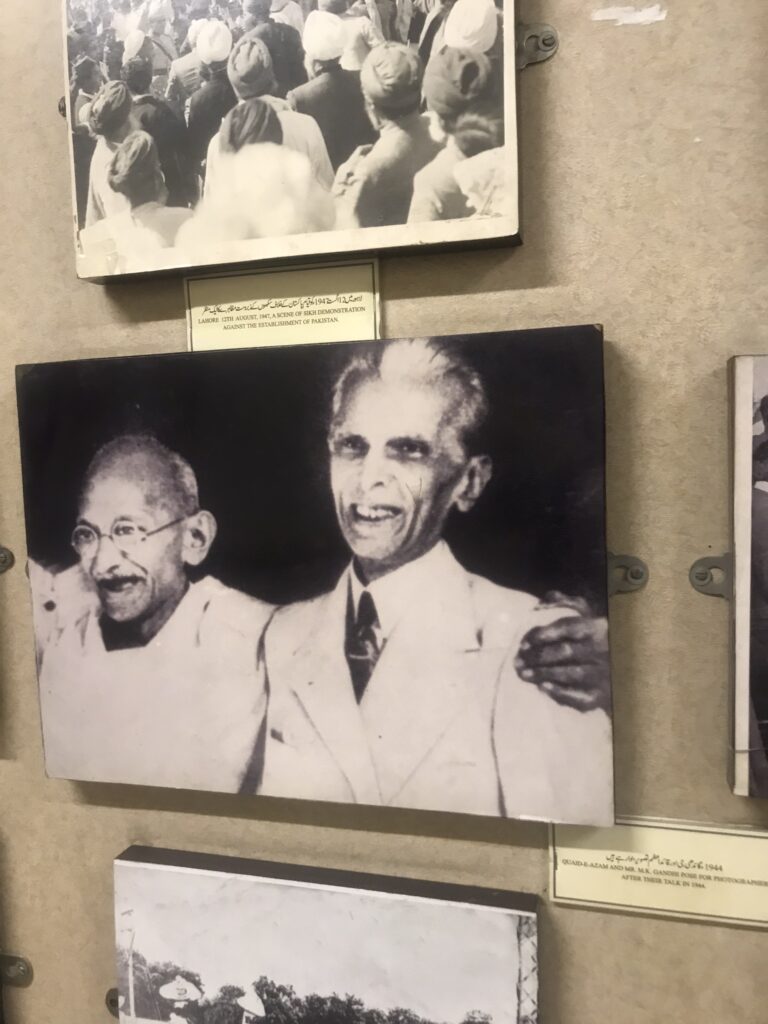
Jinnah holds the same reverence in Pakistan as Gandhi does in India
Because of their shared history, there are plenty of similarities between Indian and Pakistan. Both love cricket, both have similar cuisine, both were part of the British and Mughal empires and have plenty of remnants from those eras. Both Pakistan and India have a state called Punjab, and locals in both states even speak the same language – Punjabi.
Despite all this, it’s fair to say that Pakistan and India don’t exactly get along. This has been the case ever since the Partition, when rioting and religious violence lead to countless deaths on both sides. These days most of the problems tend to revolve around Kashmir, the beautiful mountainous region to the north of both countries. Because of some confusion at the time of the Partition, this region is claimed in full by both India and Pakistan (and also partly claimed by China).

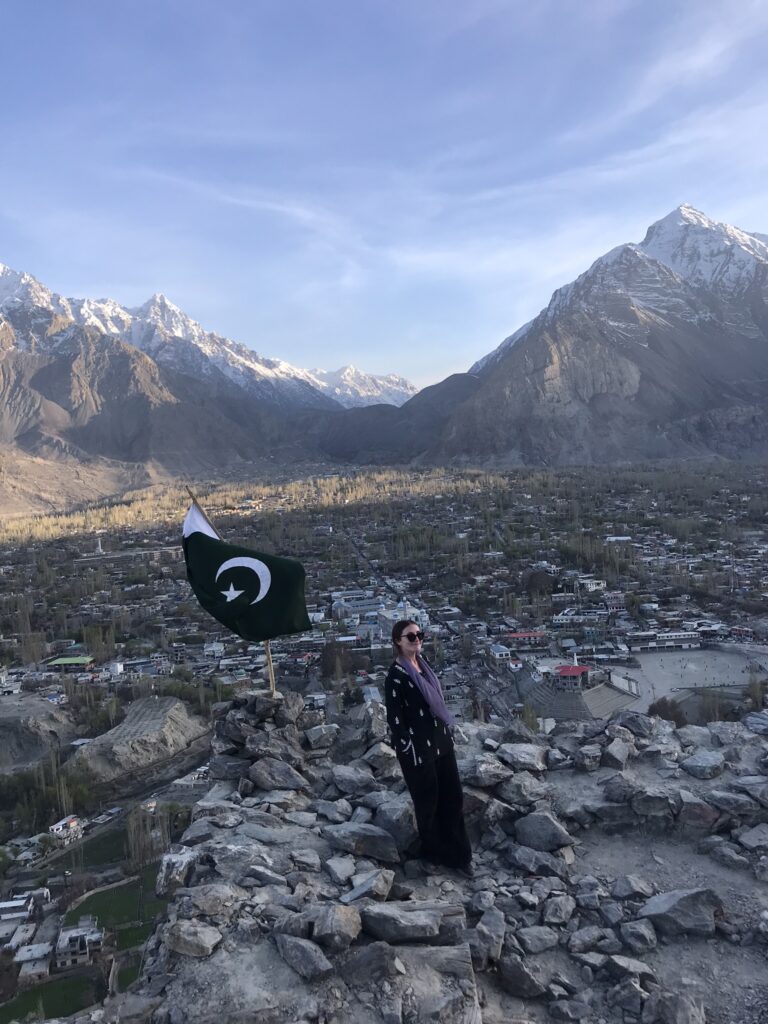
The Pakistani part of Kashmir includes Gilgit-Baltistan, containing the Hunza Valley
In reality, Kashmir is split between India and Pakistan – the Indian section comprises the Indian states of Jammu & Kashmir and Ladakh, while the Pakistan side consists of the regions of Azad Kashmir and Gilgit-Baltistan. The border between India and Pakistan in Kashmir is known as the ‘line of control’, as neither side wants to acknowledge that it is a real border (in contrast, the border between Pakistan and China in Gilgit-Baltistan is a normal, functioning border). There is palpable ill feeling on both sides. Indian Bollywood movies still contain stereotypical depictions of Pakistani villains, fuelling hatred. Relations are frosty and can become heated, sometimes boiling over. Border skirmishes occur from time-to-time.
We entered Pakistan from India via the Wagah land border crossing between Amritsar and Lahore, which was closed a few weeks after we visited. Click here for my blog post about the experience. People in India were shocked when we said that we would be visiting Pakistan and told us that we would immediately be abducted by terrorists. We weren’t; however I can confirm that traveling in Pakistan is a very different experience to traveling in India.
Pakistan is home to a wide variety of landscapes and cultures
Geography & culture
Pakistan is a land of snow-topped mountains, vast plains, rich river deltas and desolate deserts. It is a land of opposites, with fresh snow falling in Gilgit-Baltistan on the same day as the temperature hits 38 degrees celsius in Lahore. It has some daunting neighbours in the shape of China to the north-east, India to the east, Afghanistan along its north-west border and Iran to the west.
Pakistan lays claim to the second tallest mountain in the world – K2 (or Karakoram 2), which has a higher mortality rate for climbers than Everest. The Karakoram mountain range to which K2 belongs dominates the north of the country alongside the Hindukush and Himalayan ranges. Balochistan to the south-west is framed by arid desert and touches the Arabian sea. The Indus river basin between these areas cuts through the center of Pakistan like a spine descending from the mountains. Over 5,000 years ago, this great river delta was one of the cradles of civilization for the Harappa people, otherwise known as the Indus Valley civilization – this is one of the three recognised early civilisations in the world, alongside Egypt and Mesopotamia. Interestingly the name ‘India’ comes from the Indus river, although it now only flows through a small part of the territory of India in the Indian-administered part of Kashmir.
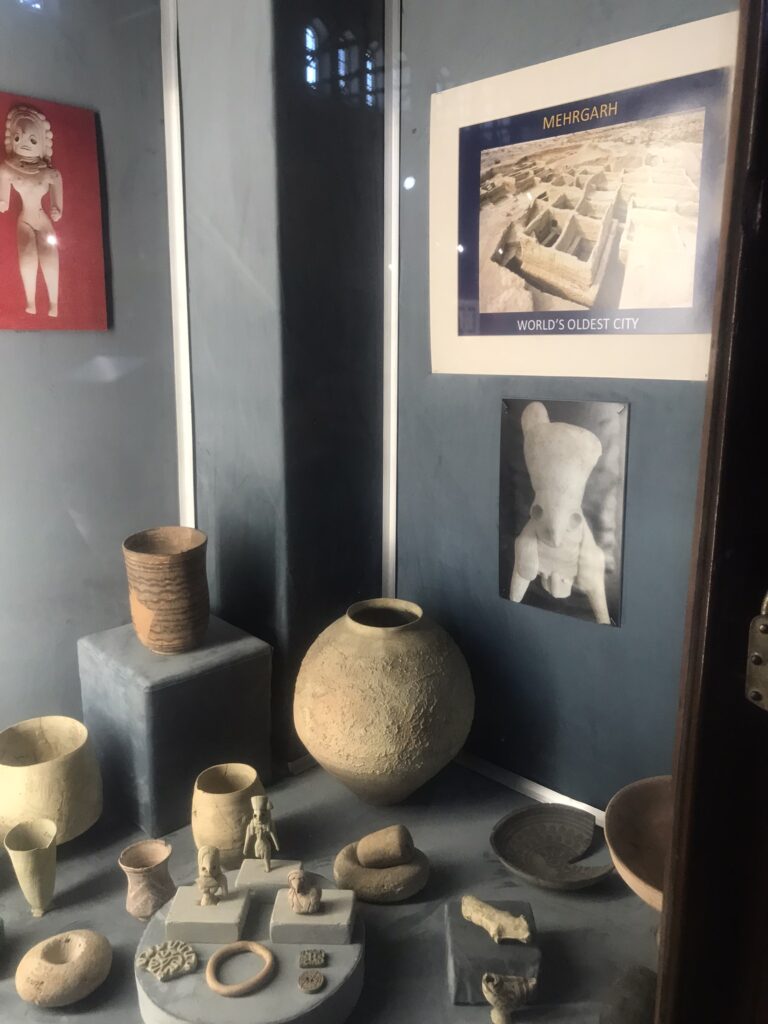
The Indus Valley Civilisation is one of the oldest in the world
Pakistan is especially fascinating for the diverse and unique communities of people who continue to live undisturbed in remote regions, such as the Wakhi and Balti in Gilgit-Baltistan and Balochi people in Balochistan – preserving their distinct culture (language, dress, beliefs, traditions, crafts and way of life). Many of these groups have been studied by anthropologists in an effort to document their cultural identity before it is lost. Check out Asra Hussain’s Youtube page for her experience with the Wakhi and Burusho People.
Pakistan is not one homogenous nation – ethnically, linguistically or religiously. In Lahore, the local population speak Punjabi as their first language and retain a similarity in character and culture with their Indian Punjabi neighbours. Languages like Pashto and Sindhi dominate the north-west state of Khyber Pakhtunkhwa and the south-east state of Sindh respectively. In Gilgit-Baltistan, there are a myriad of local languages spoken such as Wakhi, Burushaski and Shina alongside the national language, Urdu. Local people literally look different in the Karakoram mountains with fairer complexions, blue eyes and even ginger hair and beards on occasions. We saw local people in the mountains that we thought looked more Irish or Scottish than typically Pakistan in appearance. While the majority of Pakistanis are Sunni Muslims, the Ismaili Shi’ite branch of Islam is dominant in some parts of Gilgit-Baltistan, with an outwardly more liberal version of Islam practised.
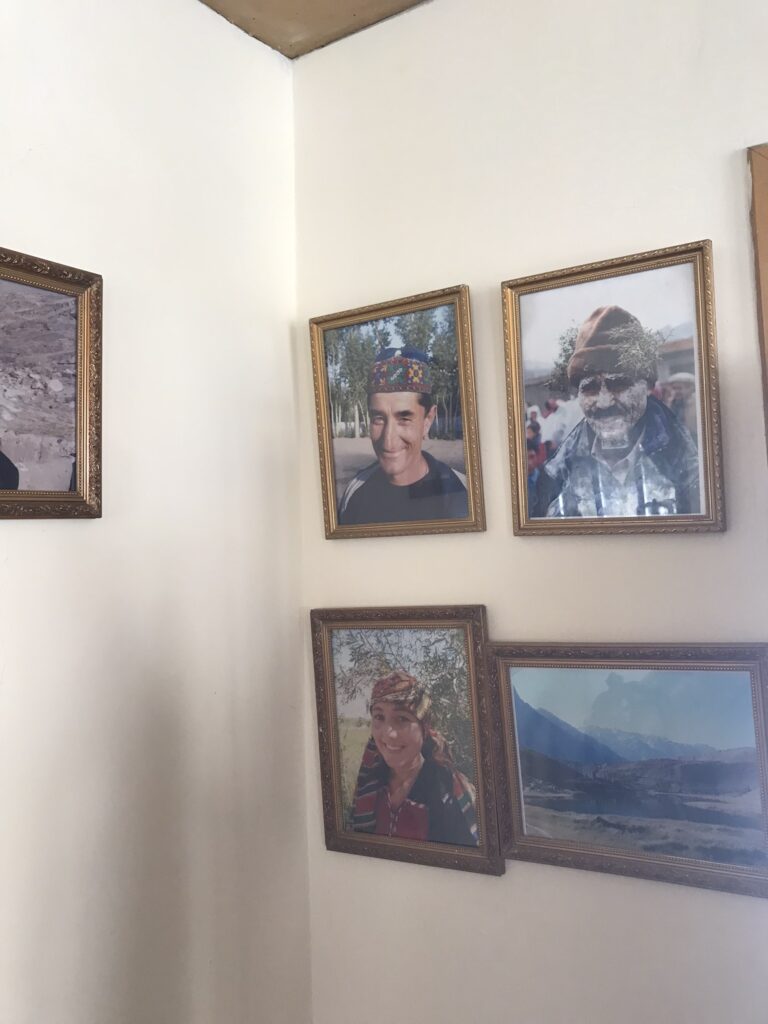
There are many different ethnic groups in Pakistan, each with their own culture and traditions
The national and unifying language of Pakistan is Urdu, which shares some similarities with Hindi (the national language of India) – the biggest difference is that Urdu is written in a modified version of the Arabic script, making it impossible for Hindi speakers to read. Urdu is not a first language for many Pakistanis, but it is widely understood by most of the population. Even though Urdu is the national language, we were surprised by how widely English was spoken. Interestingly, like in India, English is still one of the official languages of Pakistan and used by the government for the drafting of new legislation and laws, as well as playing a prominent role in education. We found that in general the levels of English seemed to be much higher in Pakistan than in neighbouring India – at least in the places that we visited.
Pakistani cuisine is very meat heavy with local specialities in each region. We particularly enjoyed handi (an often-boneless Pakistani curry), karahi (another Pakistani curry usually with chicken) and biryani – these were popular dishes everywhere we visited. It was nice to sink our teeth into some beef after some months spent in India. Barbequed meat and kebabs are also very popular in Pakistan.
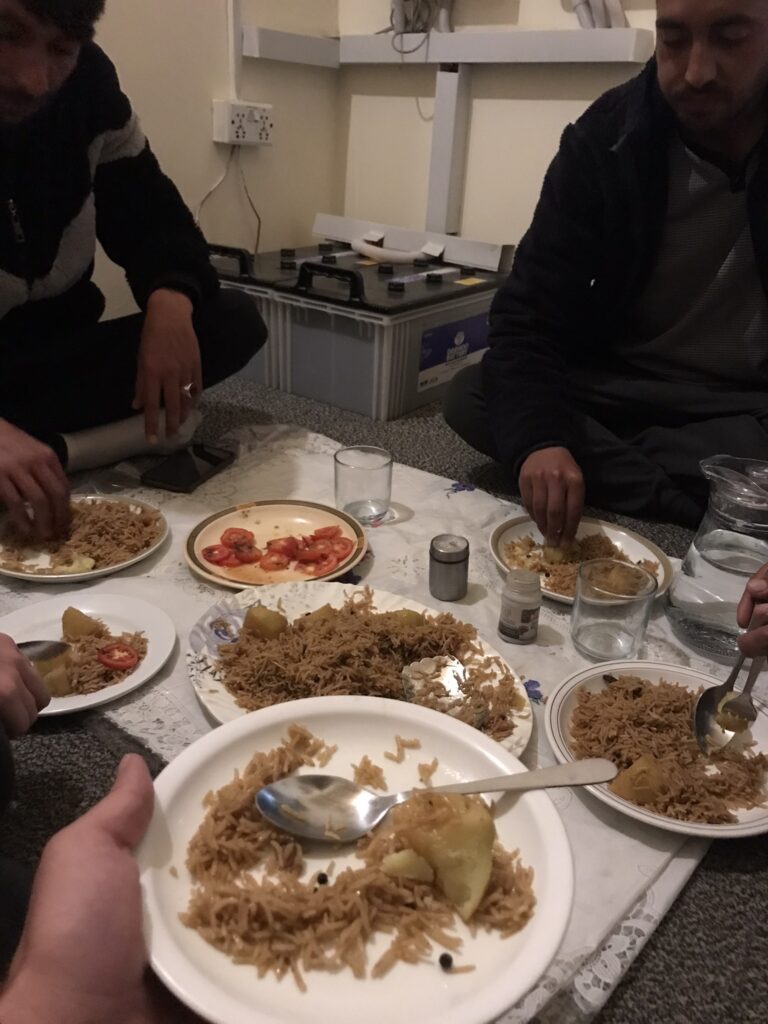
Cuisine in Pakistan ranges from classic favourites like biryani to obscure regional foods like this extremely heavy local dish we had in Skardu
Where to visit?
The number one question we were asked when we mentioned that we were visiting Pakistan was “is it safe?”. And the answer is yes, to an extent. Some parts of Pakistan are definite no-go areas, while other parts of the country are contentious and may be difficult for foreign travellers. However, there are definitely parts of Pakistan that can be visited independently with no problems – in fact these happen to be some of the most rewarding parts of the country!
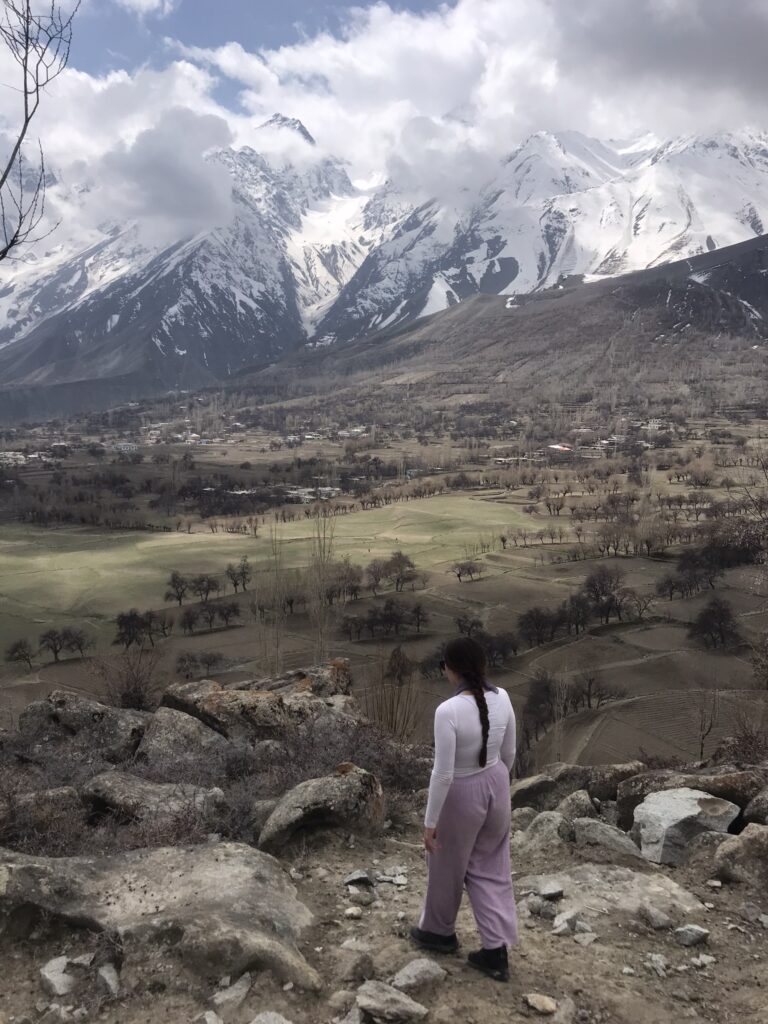
Gilgit-Baltistan is a spectacular region and totally safe to visit
We spent most of our time in Pakistan in the Gilgit-Baltistan region. Although it’s a part of the disputed territory of Kashmir, Gilgit-Baltistan is arguably the safest part of the country to visit and also the area with the most tourist infrastructure. The cooler climates in the region make it a popular domestic tourist destination, heaving with Pakistanis from Punjab and Sindh during the scorching hot summer months in those states. Filled with snow-capped mountains, rivers and alpine plains, it’s also one of the most beautiful places with some of the most breathtaking landscapes in the world.
As well as Gilgit-Baltistan, we also visited the cities of Lahore and Islamabad. These cities are a little more cosmopolitan, have relatively liberal populations by Pakistani standards and are therefore seen to be more accessible for foreign visitors. I can happily vouch for all these places being safe and welcoming for foreign visitors, as long as you use your common sense. The friendly welcome and hospitality we received from the Pakistan people in the regions we visited was second to none. People seemed legitimately pleased to see us and eager to ensure we were happy and safe.
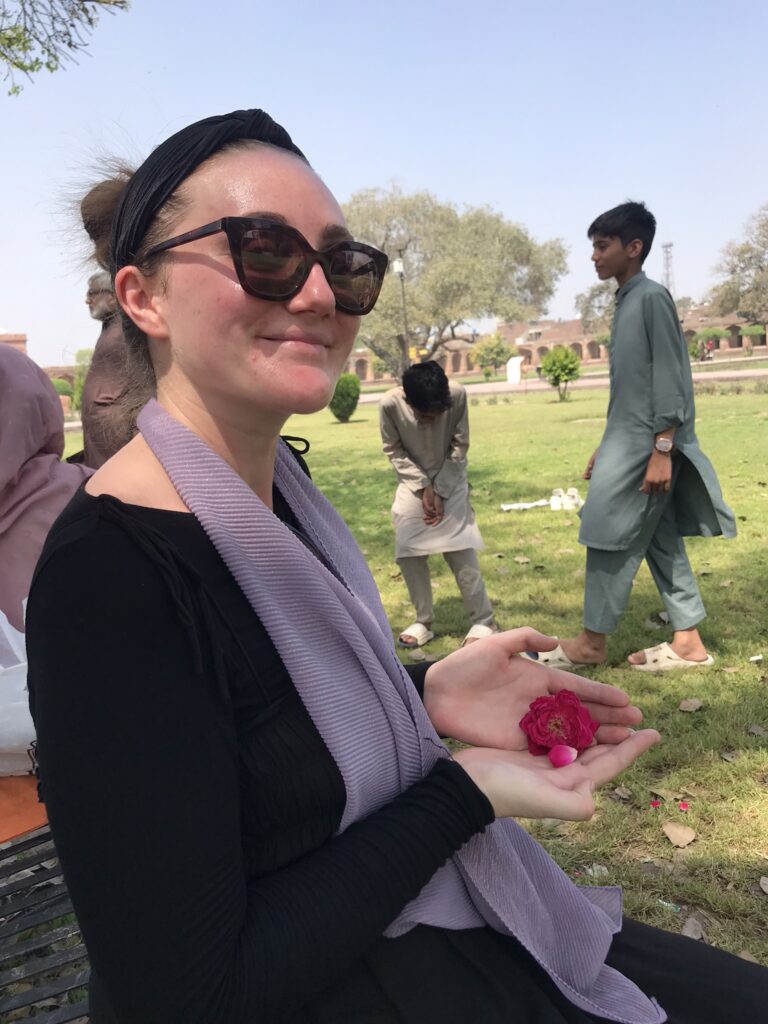
All the people we met in Pakistan were so gracious and welcoming – these young boys who were visiting the Tomb of Jahangir with their family picked flowers for me and Dan
Because we were at the end of a long and tiring trip through the Indian subcontinent, we decided not to stretch ourselves and venture too far off the beaten track in Pakistan (after all, Pakistan itself is off the beaten track for most travelers). There are several other places in the north of the country that we would’ve loved to visit, such as Chitral, the Kalash Valley, Swat Valley and Peshawar. People from Peshawar and the wider Khyber Pakhtunkhwa (KPK) region have a reputation for hospitality and this was evident whenever we encountered people from that region in other parts of Pakistan. However some of these places can also be extremely conservative and have been vulnerable to militant Islam and problems spilling over from neighbouring Afghanistan in the past.
As well as KPK, the entirety of the country south of Lahore was pretty much off-limits for independent travelers at the time of our visit. Although it is technically possible to travel there, we heard some first-hand accounts of foreigners who tried to visit the city of Multan and other places in the south of Punjab being provided with a mandatory police chaperone for their own protection – this is done because Pakistani government are very keen to ensure the safety of foreign visitors. It sounds great in theory but the chaperones often forbid tourists from walking around freely, greatly restricting their movements and freedom to explore. If you do want to visit the south of Pakistan outside of Karachi, it’s probably best to go on an organised tour for now.
Avoid restricted border areas with India as you never know what might happen. Parts of the Karakoram Highway around Chilas have been considered unsafe for foreigners in the past and we heard reports of taxis carrying foreigners being prevented from traveling on these stretches after dark. It’s also best to give Balochistan a wide berth for the time being as the situation is pretty volatile. Balochi separatist attacks have been on the rise in recent years as insurgent groups demand greater autonomy and control of their land.
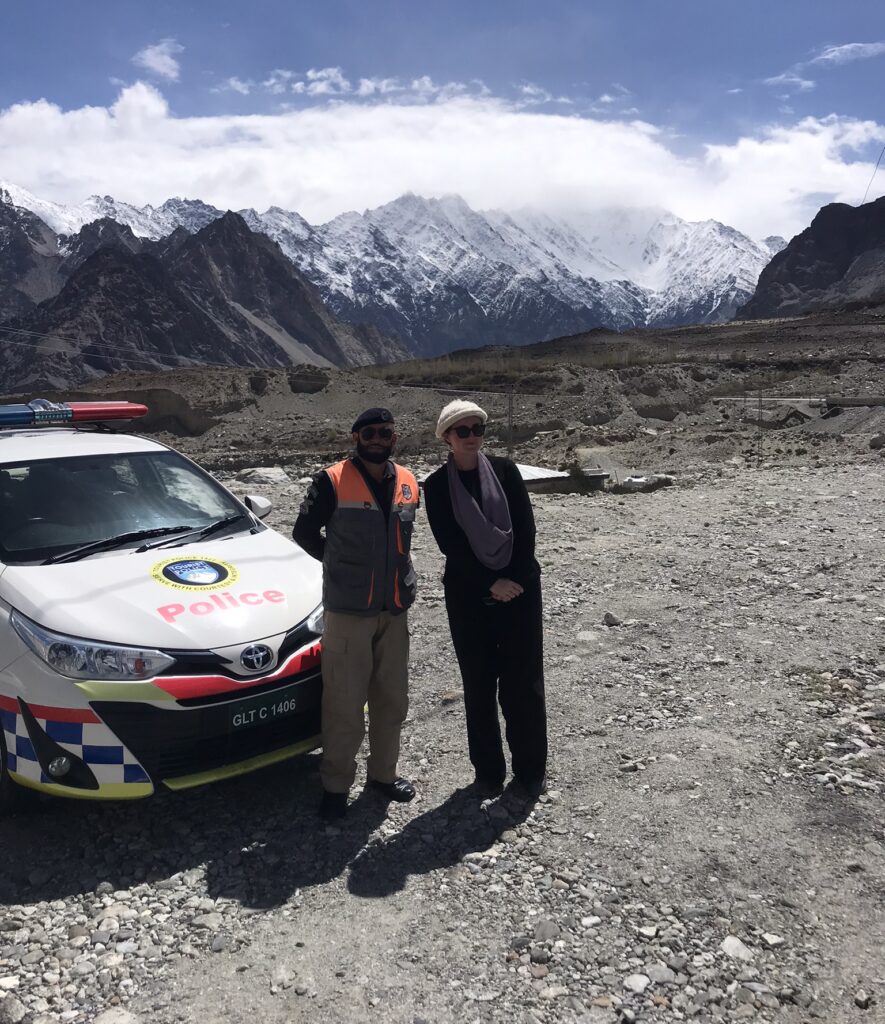
The parts of Pakistan that we visited felt super safe – the local authorities are very keen to protect foreigners
We visited Pakistan in April – although it was ridiculously hot in Lahore, this is one of the best times to visit Gilgit-Baltistan, when the valleys are blanketed in cherry and apricot blossom at the very start of the summer season and when things are starting to open back up after the winter but before the arrival of the hordes of domestic tourists.
Cultural nuances
It really goes without saying but there are obviously significant cultural differences between Pakistan and many other nations, particularly Western nations. Pakistan, is generally speaking, a very conservative Islamic country. When visiting it’s important to be open and non-judgmental to the local cultural nuances, just as you would expect any guest in your own country to be. Pakistan is not the place for short shorts or closed mindedness.
Religion permeates everything in Pakistan, from travel prayers on planes and buses to the call to prayer being played over the loudspeakers in the airport. Museums and attractions may temporarily close on a Friday afternoon for prayers. In Pakistan, blasphemy is a crime which is punishable by death. People dress modestly, fast during Ramadan, eat halal food and avoid products which are considered haram like alcohol, pork and other intoxicants.
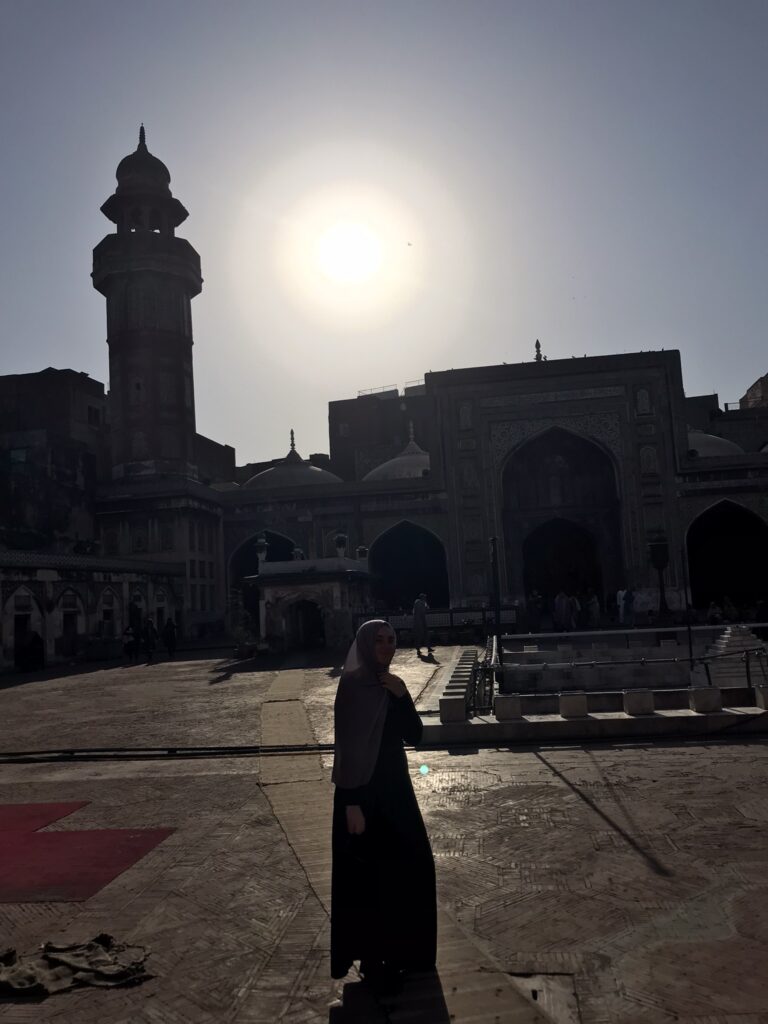
Pakistan is home to many grand mosques – the Wazir Khan mosque in Lahore reminded us of Uzbekistan
When traveling through Pakistan, you of course need to adhere to the cultural sensitivities and show respect to local customs. However, as non-Muslims I can say that we didn’t feel uncomfortable in Pakistan or really encounter any problems at all because of the difference of religion. On the contrary, people were curious about us but also very courteous, warm and welcoming. Ladies will need to cover their hair in mosques and religious buildings, but I didn’t feel the need to cover my hair the rest of the time in the places we visited. We also made sure to describe ourselves as Christian when asked – a good idea even if you’re not actively religious. Click here to check out my Pakistan travel tips including advice on dealing with issues of marriage, religion and clothing.
Hospitality is the backbone of society in Pakistan. We often find outstanding hospitality in Islamic countries and Pakistan was no exception. From being invited in for refreshments by a friendly family in Skardu to a fellow passenger in a shared taxi paying for our tea at a roadside restaurant without us even knowing, or rocking up at a friend of our hosts in Gulmit near Karimabad for some dried cherries and apples. Pakistanis are renowned for being good natured and humble hosts with doors wide open to guests.
In Pakistan it’s always chai time! Chai or unspiced milk tea is the answer to everything. Need waking up? Chai. Meeting friends? Chai. Tired? Chai. Unlike the herbal teas in Central Asia, we found that the chai in Pakistan was very similar to English breakfast tea, milky and rich in consistency which was an unexpected delight for us.
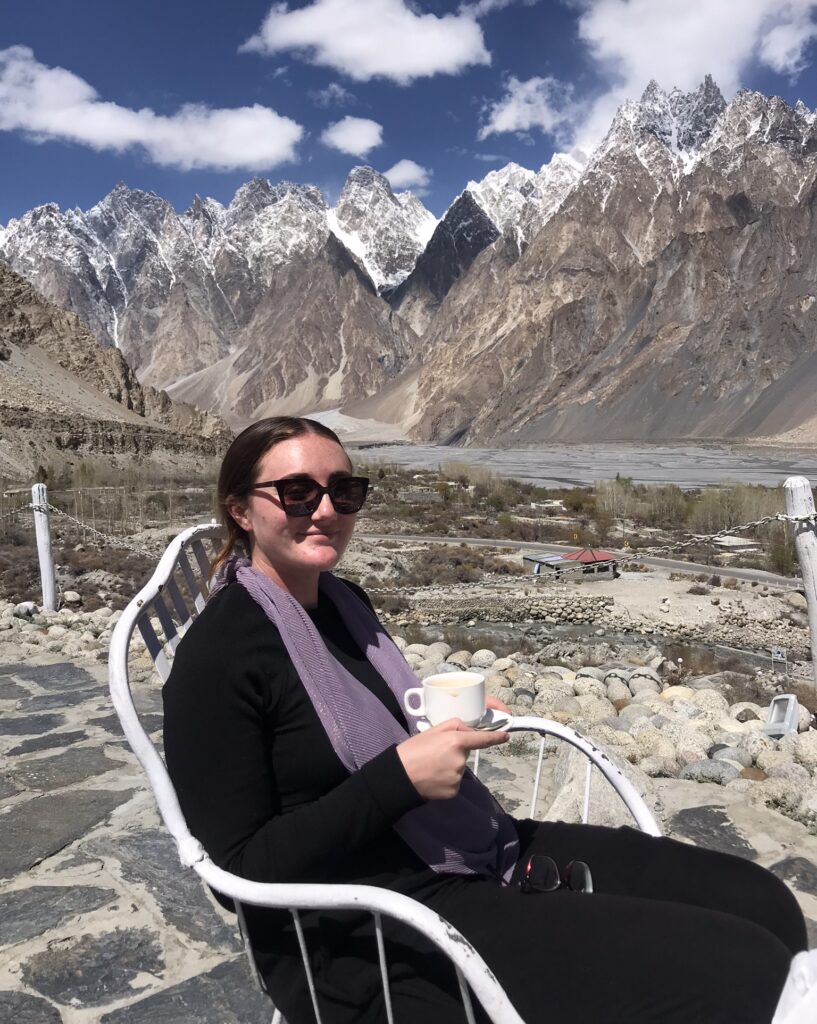
Pakistan is great for lovers of a nice cup of tea
Contrary to popular perception, in Pakistan I found that there is actually great respect for women. As is the cultural norm in many Islamic countries, men are forbidden from touching women that are outside of their family. I found men to be very gracious towards me, often giving me a wide berth on the pavement or giving me more space to pass by without touching. This made a nice change from India where I was inundated with men getting too close, trying to touch my hand or take photos with me.
Most Pakistani men wanted to shake hands and take photos with Dan rather than me – a sign of respect. However despite giving me plenty of space, the men were not dismissive; they were open to speaking to me and accepting of my presence. I didn’t know what to expect interaction-wise before arriving but I didn’t experience any disrespect or prejudice personally. I wasn’t ignored or spoken over at all! All my interactions with Pakistani men were very normal and amiable interactions. The general rule is unless a man offers to shake your hand (this only happened to me on three occasions in 16 days) simply place your right hand over your heart as a respectful sign of greeting.
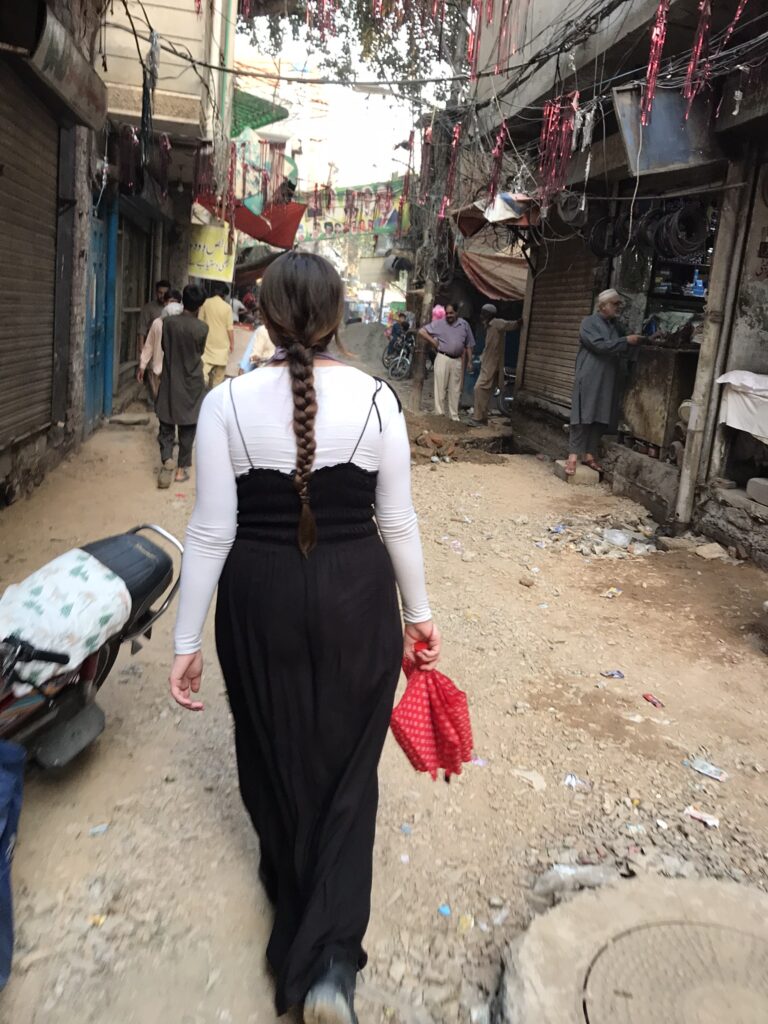
As a foreign woman I was fine walking the backstreets of Lahore with Dan
Pakistan is often portrayed in a negative way in the media but Rabia, my Pakistani friend from Lahore, wanted to make clear that Pakistan is by no means Afghanistan; women can have high-flying careers, wear western clothes and makeup, watch Hollywood movies on Netflix, drive fancy cars, study to be doctors and have opportunities open to them. However women’s freedom often depends a lot on their family situation and background. For women from wealthy, liberal, urban-based (Lahore, Islamabad, Karachi) families, opportunities are available. However those from more conservative or rural areas or at the bottom of the social pile may find that their options are a lot more limited.
I would be remiss not to talk about the other problems facing Pakistan. Sadly, poorly-treated child domestic workers are a reality in Pakistan at present among middle and upper classes. Pakistan is one of the only parts of the world where polio has not been eradicated, while some rural parts of the country remain isolated geographically and culturally. The threat of Islamist insurgency and terrorism in certain parts of Pakistan remains a concern, with problems spilling over from neighbouring Afghanistan in the recent past as well as attacks carried out by militant separatists in Balochistan. Chinese resource mining is also becoming a malignant factor in the country in order to repay debts to the International Monetary Fund and China. The people we spoke to about this issue predict protests in the future against the selling off of local natural resources to pay back debts accrued by the national government.
Tips for travellers
Pakistan can be a culturally sensitive but also rewarding travel destination, filled with warm, friendly and interesting people. We picked up a few pointers along the way to make life easier when traveling independently in the country. Click here to check out my top Pakistan travel tips!
I also wrote a blog post about transportation in Gilgit-Baltistan – click here to view it!
Lahore
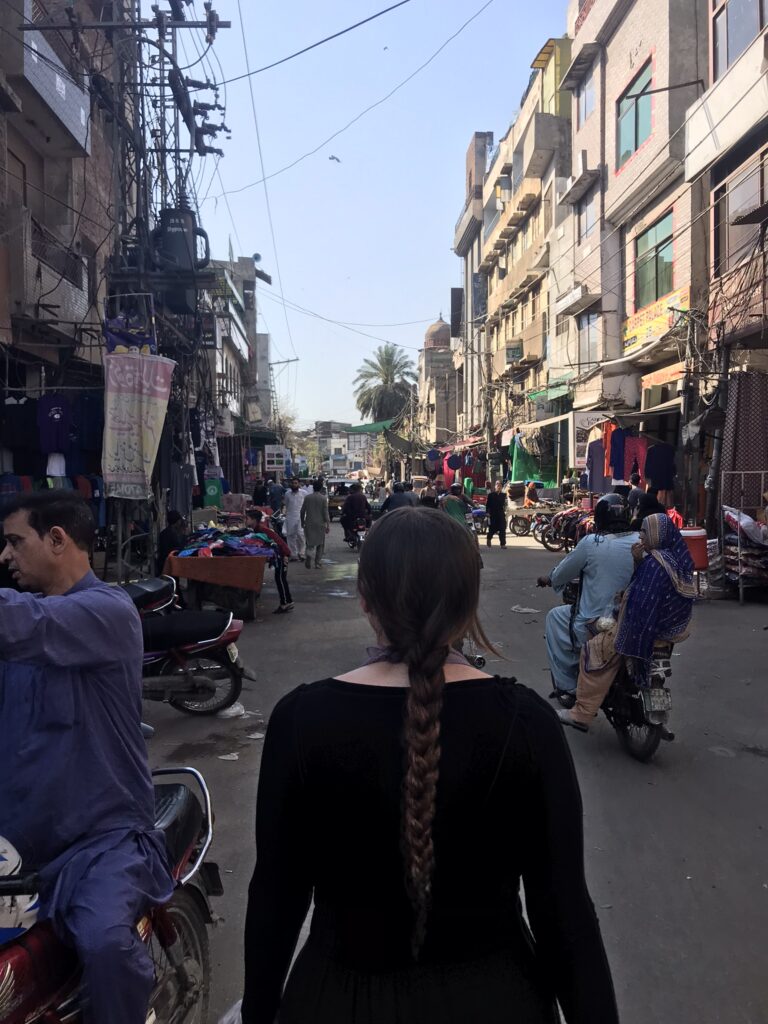
A stone’s throw away from the India-Pakistan border, Lahore is the largest city in Pakistan’s Punjab region. It has been described as the ‘Paris of the East’ for its relatively cosmopolitan, liberal atmosphere and reputation as a center of literature and music. And while in reality Lahore is very different from Paris, it is most definitely a unique and vibrant city with a strong cultural heritage and many interesting sights and places to explore. Lahore represents the old and new; from the medieval Walled City with its tangled web of confined streets and passageways near Delhi Gate to the wide boulevards and extravagant mansions close to Lahore Zoo. With two UNESCO World Heritage sites (Lahore Fort and Shalimar Garden), world-class museums, the fascinating Mughal-era Tomb of Jahangir and the most iconic mosque in Pakistan to boast about, it’s an unmissable stop on any Pakistan itinerary.
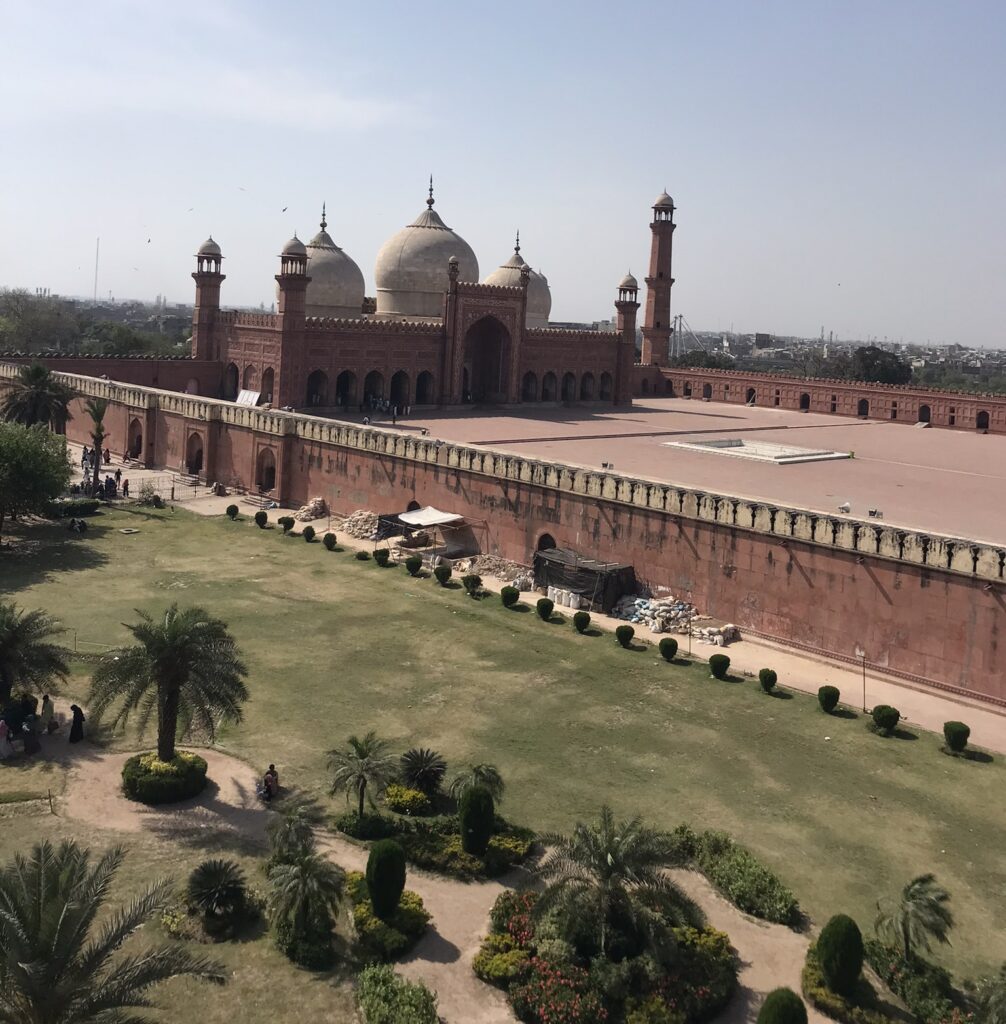
Badshahi Mosque is one of the iconic symbols of Lahore
Lahore has been inhabited for many centuries but reached its peak during the Mughal period in the 1600s. The Mughal influence can still be felt throughout the city’s many buildings and monuments; it defines the culture and architecture of Lahore to this day. After the decline of the Mughals, Lahore then passed into the hands of the Sikh Empire and then later the British Empire, both of which have also played a major role in shaping the city’s cultural identity.
Lahore was our first stop in Pakistan. We didn’t really know what to expect. Strolling around the streets (we did a hell of a lot of walking there!) we weren’t approached or bothered once – a welcome change after the relentless hassle of the north of India! We also immediately noticed that there was minimal traffic chaos, fewer honking horns and no over-the-top litter compared to the place we had just come from. It’s interesting to note that Lahore and Amritsar used to be sister cities but were torn apart by the 1947 Partition. Punjabi continues to be the first language of the majority of residents of Lahore to this day, just like the Punjab region in India.

For some reason, table football (foosball) is everywhere in Lahore – Dan was soundly beaten
Lahore is a huge city with an enormous population, but most of the time it felt strangely relaxed, not really overcrowded or chaotic at all. The major exception is the Walled City and Delhi Gate area, which is teeming with people. Still, even this area wasn’t so busy that it was unpleasant to walk around – the human traffic jams weren’t on the same level as in places like Dhaka and New Delhi. The Walled City is the historic centre of Lahore, with Delhi Gate being the overcrowded eastern entrance to the Walled City. Delhi Gate actually faces New Delhi in India, dating back to the time of the Mughal Empire – interestingly, in New Delhi there’s a sister gate named Lahori Gate.
The Walled City can be both manic and peaceful, an atmospheric labyrinth of narrow streets and alleys which is the heart of the old town in Lahore. Inside is a bit chaotic with pedestrians and mopeds jostling for space in the winding alleys and walkways. A mix of residential and commercial properties with bustling market streets selling an array of products from metalware to woven beds and luxurious silk dresses. Well worth a visit for the buzzing atmosphere and historic mosques! Outside of the Walled City area, Lahore is a mixture of wide, modern streets and winding, medina-style residential areas which we felt comfortable enough wandering around and exploring on foot.
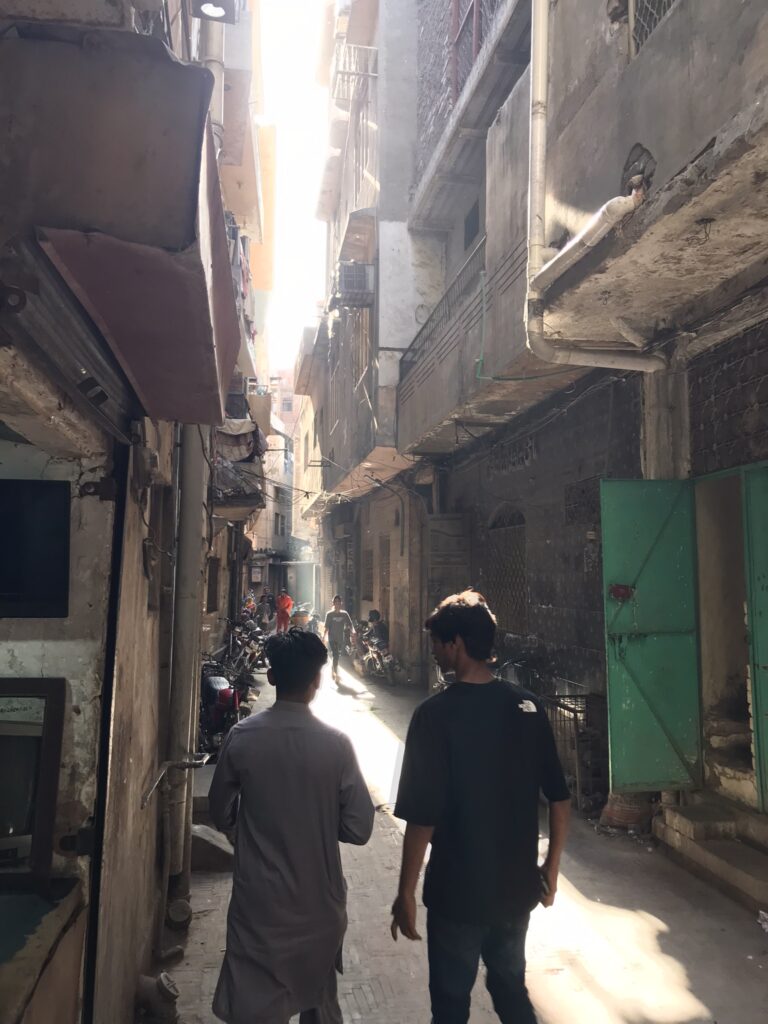
There is plenty going on in the Walled City
Lahore can get incredibly hot. Temperature-wise the best time to visit the city is in the winter months of December, January and February, however pollution levels can be much higher in these months and this is also not the best time for visiting other parts of Pakistan. When we visited in April, the temperatures in Lahore were already pushing 40 degrees celsius and it was almost unbearably hot. If visiting at this time of year, my best advice is to carry an umbrella with you for shade and drink plenty of water. A hotel room with air conditioning is a must!
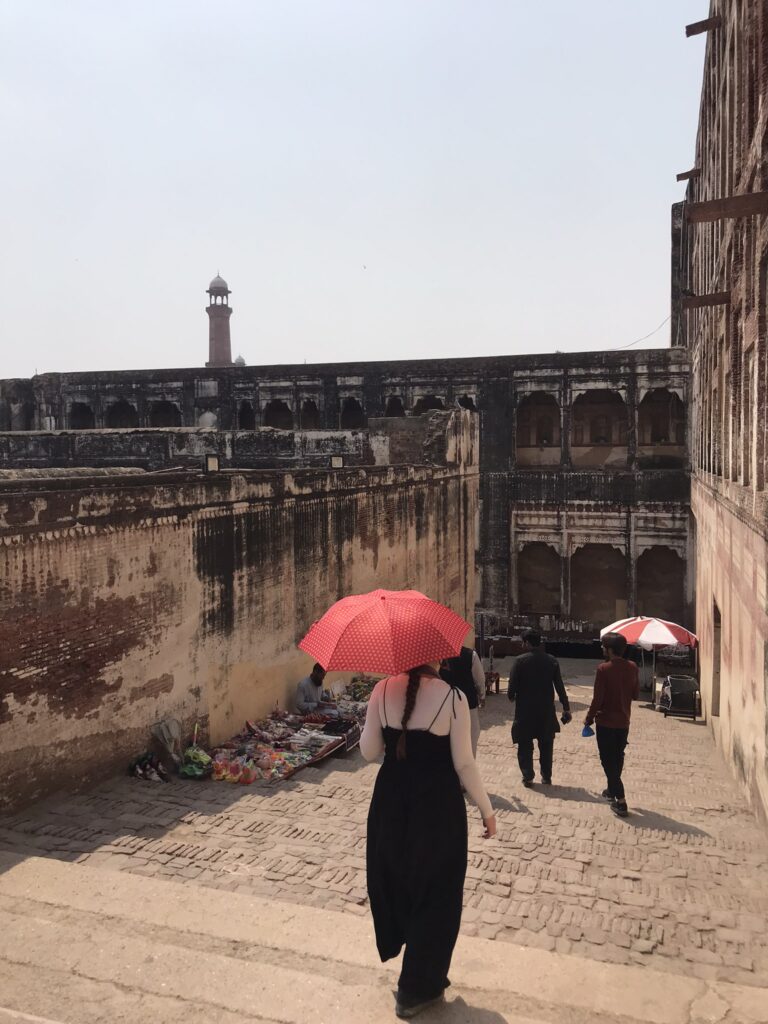
Carrying an umbrella may be cumbersome but it really helped with the sun
When visiting attractions in Lahore, it’s worth double-checking social media for any scheduled or unscheduled closures. We didn’t do this and were sorely disappointed to find that both the entire Lahore Fort complex and Shalimar Gardens were unexpectedly closed on the same day. We had to shuffle around our itinerary and never actually made it into Shalimar Gardens in the end as a result. From speaking with locals and also based on our own experiences, the opening of both major and minor attractions in Lahore can be a little bit erratic as they are regularly used to host delegations, functions, festivals, public holidays or any manner of other things which may result in temporary closures.
Public transport in Lahore
To get around the city using public transport, the metro bus and metro are the way to go. The metro in Lahore is a modern, shiny new system which works well. The downside is that it currently only has one line and not particularly good coverage of the major touristic sites.
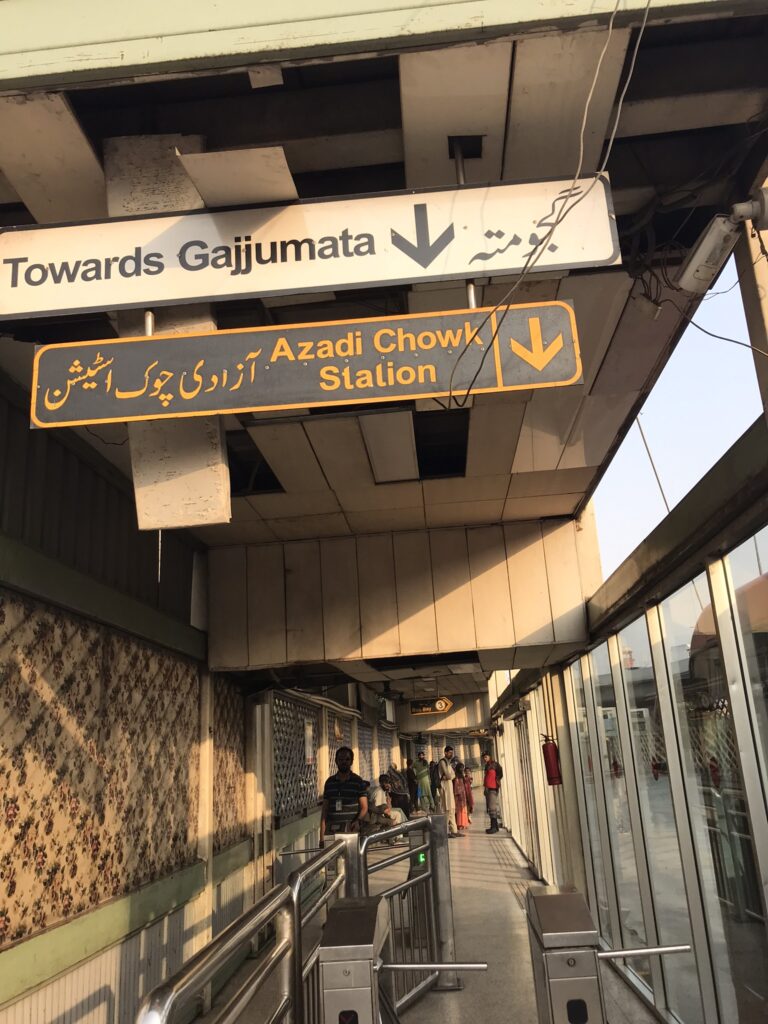
A typical metro bus station in Lahore
The metro bus was a new experience for us – it’s literally a bus that operates on a set route like a train or tram in its own special lane. The tickets are super cheap and the buses are very regular – roughly every 2-3 minutes. There’s an unofficial area for women and children at the front of the metro bus and even though I was with Dan I was encouraged to join the ladies at the front. Most of the time the air-conditioning worked on the metro bus, which was a godsend when it was baking hot outside. I also had some interesting interactions with local women on the metro bus, who were genuinely curious and eager to talk to me.
Lahore Fort complex and Jahangir’s Tomb are both situated close to the metro bus line. Shalimar Gardens and Lahore Museum are both on the metro line. Using public transport can become a little inconvenient when you want to reach some sites as you may need to change from the metro bus to the metro. A minor annoyance but worth it to save money.
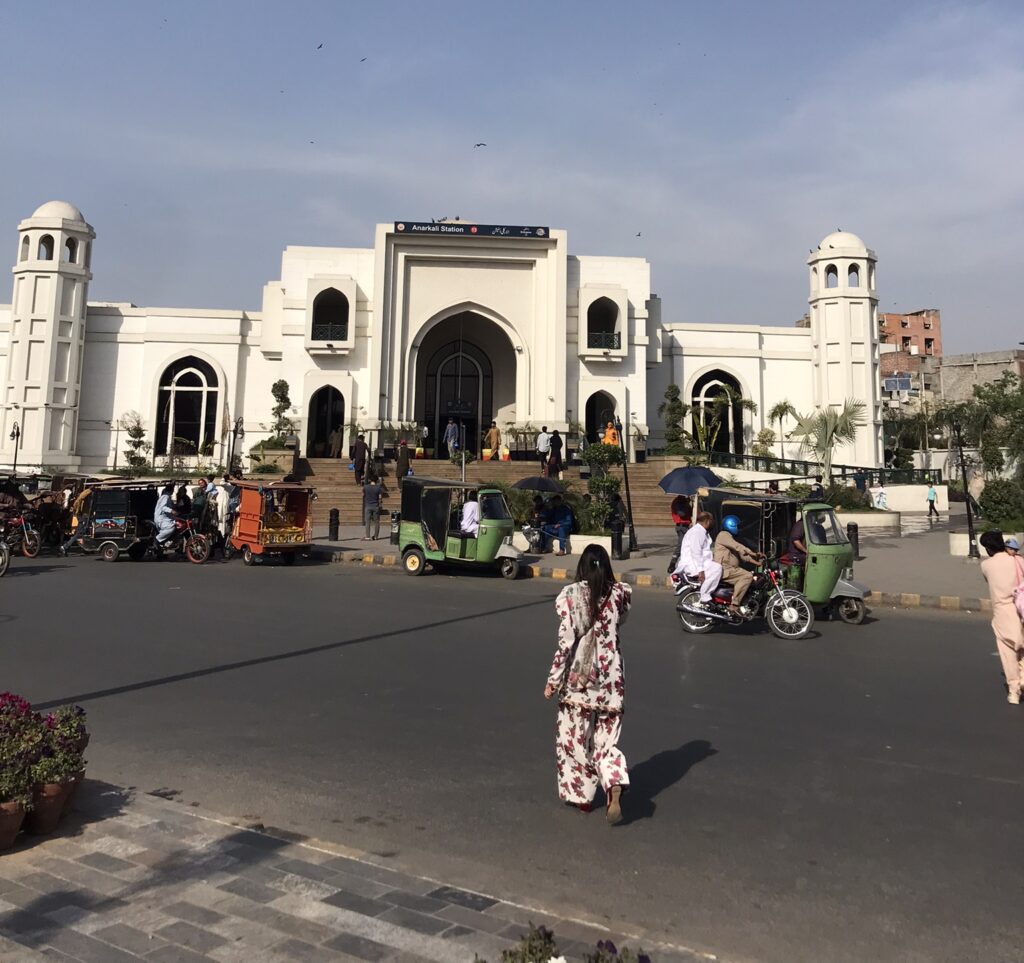
Anarkali Station is the best place to change between the metro and the metro bus – just around the corner is the MAO College metro bus station
If public transport is not your cup of tea, InDrive works well in Lahore. It’s similar to Uber except you can negotiate a price for your journey and choose your own driver (always go for the one with the highest rating).
When traveling intercity, Faisal Movers is an excellent bus company. We used them to get from Lahore to Islamabad and had a great experience. They offer executive business class buses which include a fancy executive lounge with free hot drinks and water cooler, a snack pack and water bottle en-route and an interactive screen onboard which you can use to play movies or Qawwali (sufi devotional music), which makes the journey fly by. There are regular buses at very reasonable prices considering the level of service. The experience with Faisal Movers is honestly one of the best and most luxurious intercity bus experiences I have ever had in any country. The Faisal Movers terminal that we used in Lahore is located here – no need to buy a ticket in advance as they have a ticket office at the terminal.
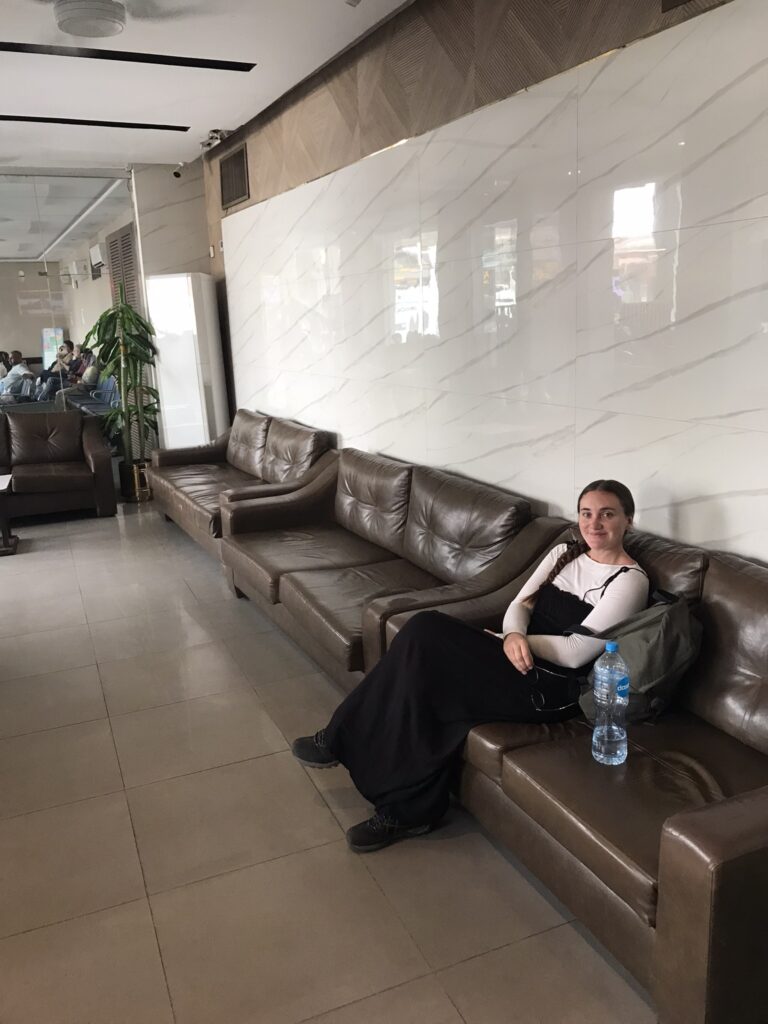
Chilling in the Faisal Movers executive lounge – I highly recommend this bus company
Accommodation
Most foreign visitors to Lahore choose to stay in the Gulberg neighbourhood, which is considered to be one of the most upmarket parts of town. We didn’t stay here, instead we stayed near Bagh-e-Jinnah which is a little bit closer to the centre of town. Sadly we couldn’t find any decent accommodation within our budget located along either the metro or metro bus lines, which would’ve made life a lot easier.
Imperial Suites – Spacious and stylish studio rooms with a comfortable bed, stand alone bath tub, great air conditioning and a functional kitchen area. Our stay was very peaceful and rejuvenating as the place is situated on a quiet street off the main road. There are plenty of food options nearby as well as room service if you’re feeling lazy – all food that we ordered was filling and tasty. The reception staff were also very professional and accommodating. From Imperial Suites it is just about possible to walk to The Mall and Lahore Museum, the Shrine of Shah Jamal and the metro bus station. However this walk can become a bit of a slog in the hot weather so I recommend using InDrive if the temperatures are high or you’re short on time.
Foodie Places
Fort Road Food Street, right next to Lahore Fort, is a great place to head for Lahori cuisine although it’s a tad on the touristy and expensive side. Haveli Restaurant is the most highly rated of the restaurants on the street.
Haveli Restaurant – located in a historic family house, this slightly pricey restaurant has fantastic views of Badshahi Mosque from the roof and main dining room. It also houses a small museum on the ground floor. Another quirk of the place is that they have front of house staff with dwarfism who welcome you inside and escort you to the lift. There is a small gallery area in the lobby. The food served traditional Lahore fare such as handi, karahi and a wide selection of kebabs. A gimmicky, touristy place but we liked it.
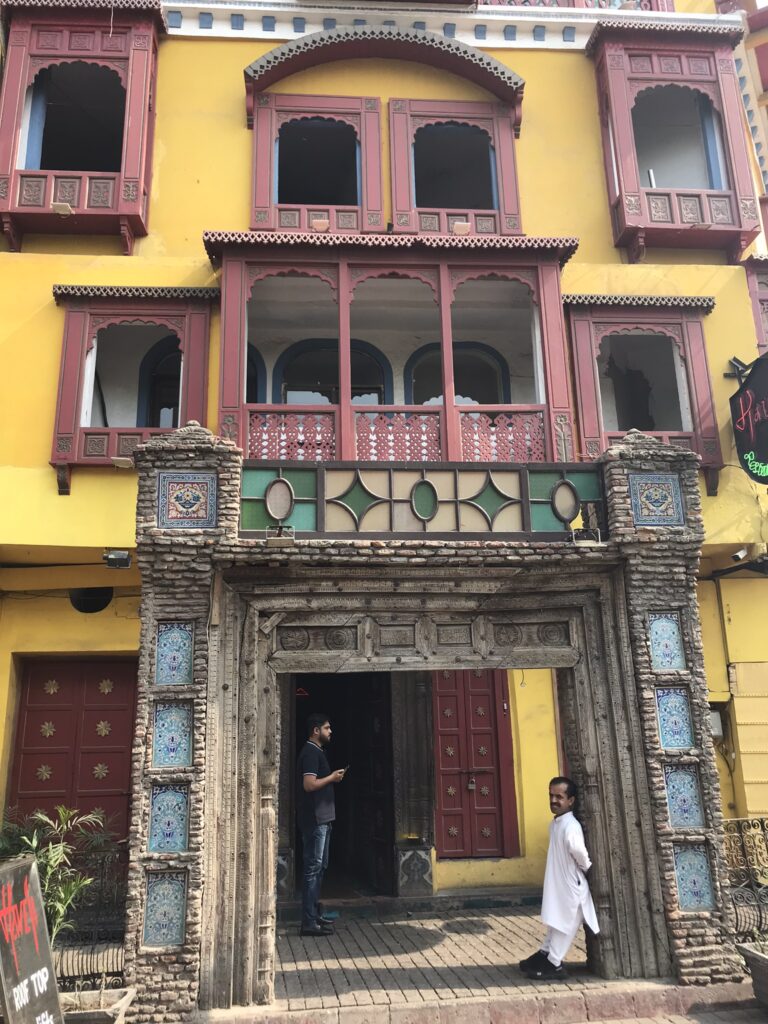
Haveli restaurant is as much about the experience as the food, but we enjoyed the mixed kebab platter including fish kebabs!
Broadway Pizza – Shadman – if you’ve got a craving for fatty processed food then Broadway Pizza is the place to go to fill up on gooey, cheesy pizza. The prices are very reasonable and the menu is in English too.
Subway – yes, there is Subway in Lahore. Not exactly an authentic Pakistani option but home comforts are needed sometimes after months on the road. We’ve tried Subway in dozens of countries and honestly the sandwiches we had in Lahore weren’t the worst. Plenty of fresh salad is always a boost.
Activities
Sufi Dhamaal at the Shrine of Shah Jamal – ONLY on a Thursday night
Every Thursday night, adherents of the Sufi order of Islam gather at the Shrine of Shah Jamal and various other Sufi shrines in Lahore to participate in dhamaal – essentially a type of religious ecstatic dance. If you’re in Lahore on a Thursday, attending a dhamaal is an unmissable experience in my opinion. The best way I can describe it is that it’s like attending a Sufi version of an underground religious nightclub.
Click here to read my blog post here for my experiences at the dhamaal!
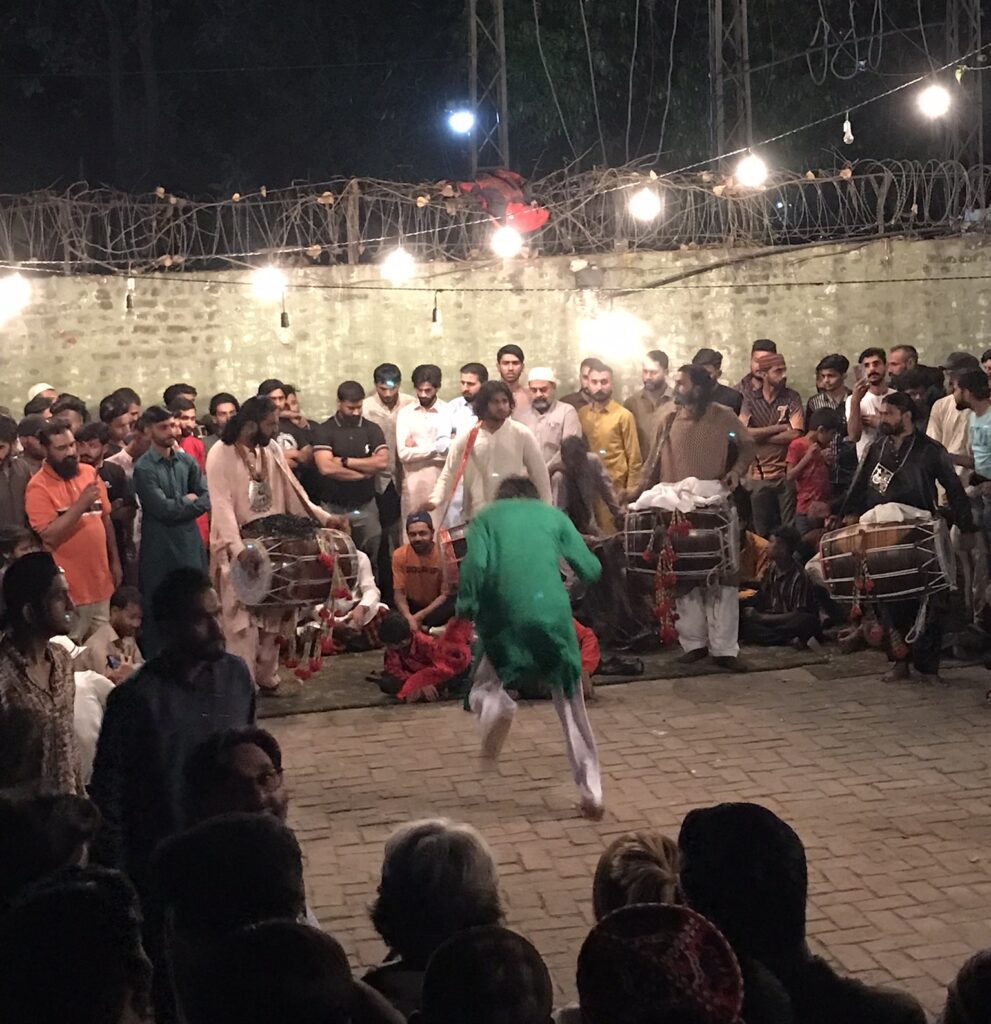
The dhamaal at the Shrine of Shah Jahan is something I can highly recommend if you’re in Lahore on a Thursday night
Guruwalk around the Walled City with stops at Delhi Gate, Gali Surjan Singh (named after a prominent Sikh doctor, after being renovated it’s now a picturesque touristy street with boutique cafes and upmarket shops), Wazir Khan Mosque (on the UNESCO tentative list, famous for its Persian-inspired design and glazed tile exterior we couldn’t help but notice similarities with Uzbekistan madrassas), Khalifa Bakers near Mochi Gate (a much-loved Lahore bakery since 1925 – almond nankhatai is the biscuit to try here!) and Sunehri Masjid (famed for its golden domes). As always, a Guruwalk is a great way to engage with and get first-hand authentic experiences and tips from a local as well as uncovering hidden aspects that you would’ve otherwise missed. This is particularly useful in the labyrinthine Walled City with its many undiscovered treats. Tip your guide fairly!
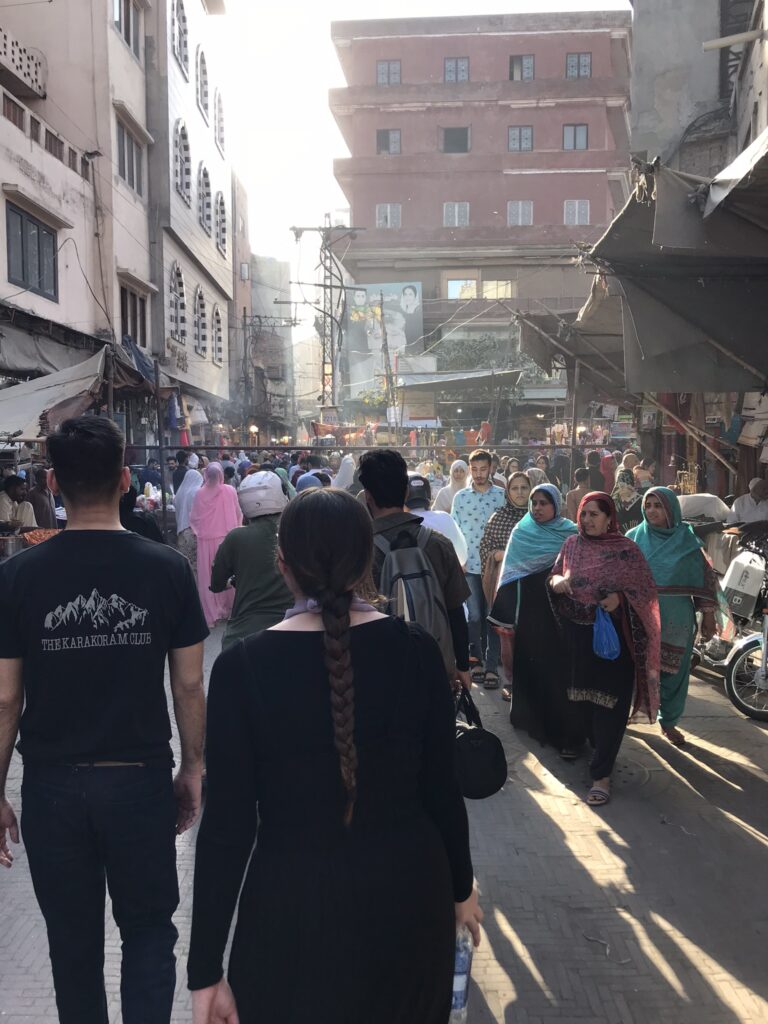
The Walled City can be a busy place
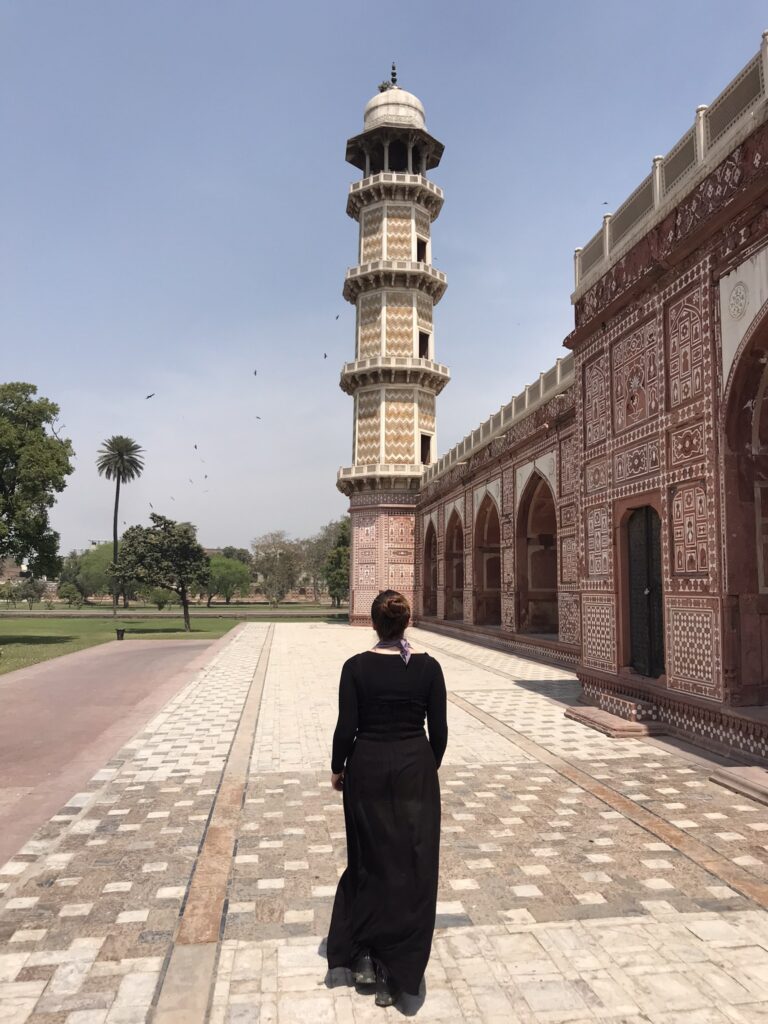
Tomb of Jahangir – a typically extravagant Mughal emperor’s tomb. This iconic landmark is situated in what used to be an extensive Mughal pleasure garden complex on the banks of the river Ravi. According to legend, the spot for Jahangir’s tomb was his favourite garden. Jahangir was buried in Lahore as he died in Kashmir and Delhi, the capital, would’ve been too far to repatriate the body of the emperor. Apparently Jahangir prohibited the building of a dome over his mausoleum, as was the style at the time. Jahangir’s son, Shah Jahan, was responsible for building this final tribute to the deceased Mughal emperor. Later, the tomb was desecrated by the Sikhs when they took possession of the city in the 18th century.
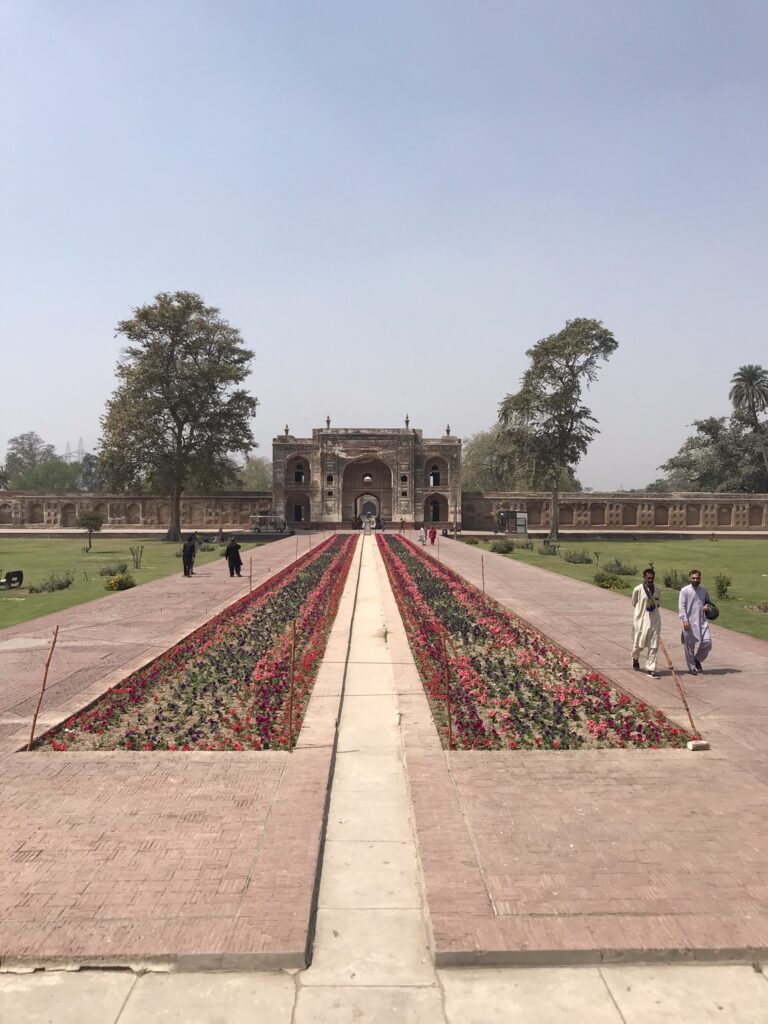
Jahangir’s tomb complex follows a typical Mughal-style garden layout
The mausoleum features typical Mughal architecture with intricate pietra dura marble inlay work in dusky sandstone, four towering gleaming white marble minarets and a Persian Paradise Garden. The symmetry and layout of the mausoleum complex is flawless. We found the gardens to be very tranquil and serene – an ideal place for a picnic or rest in the shade. There is a small photo gallery within the mausoleum showing before, during and after conservation shots, although we were asked for a tip by the attendant after leaving the room. Opposite the entrance to the mausoleum and within the wider complex is an archaic caravanserai (inn for travelers), fully functioning mosque and the tomb of Asif Khan.
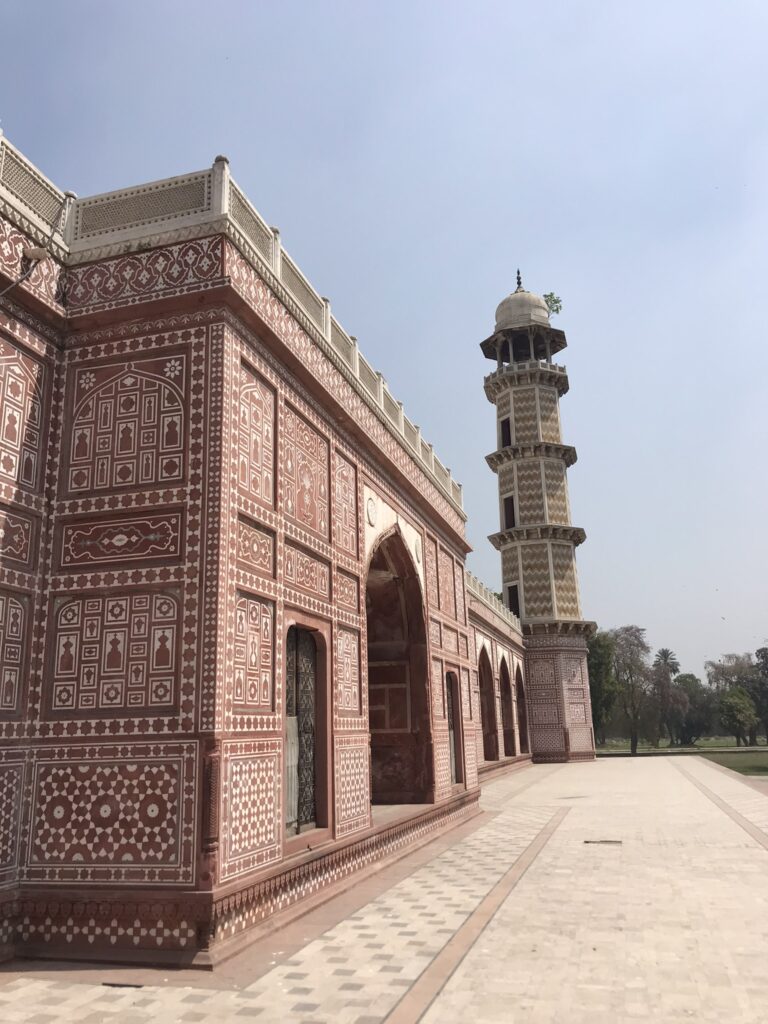
Jahangir’s mausoleum – I can never get enough of the intricate decorations on the grand Mughal structures
The Tomb of Nur Jahan (separate entry ticket) is located nearby, within easy walking distance of Jahangir’s Tomb. Nur Jahan was one of Jahangir’s wives. As well as vast gardens, this smaller sandstone mausoleum of Nur Jahan is another testament to the Mughal legacy in the city. The mausoleum is surrounded by pleasant gardens which are a nice place to take a stroll.
Both of these attractions can easily be visited using the metro bus. Just take the bus to Shahdara, which is the final stop on the line. From the station, it’s a 10 or 15 minute walk to either of the tombs. Entry for both tomb complexes is paid – annoyingly there is no combined ticket so you have to pay separately for both the Jahangir and Nur Jahan complexes, although entry is quite cheap (500 PK rupees for foreigners when we visited).
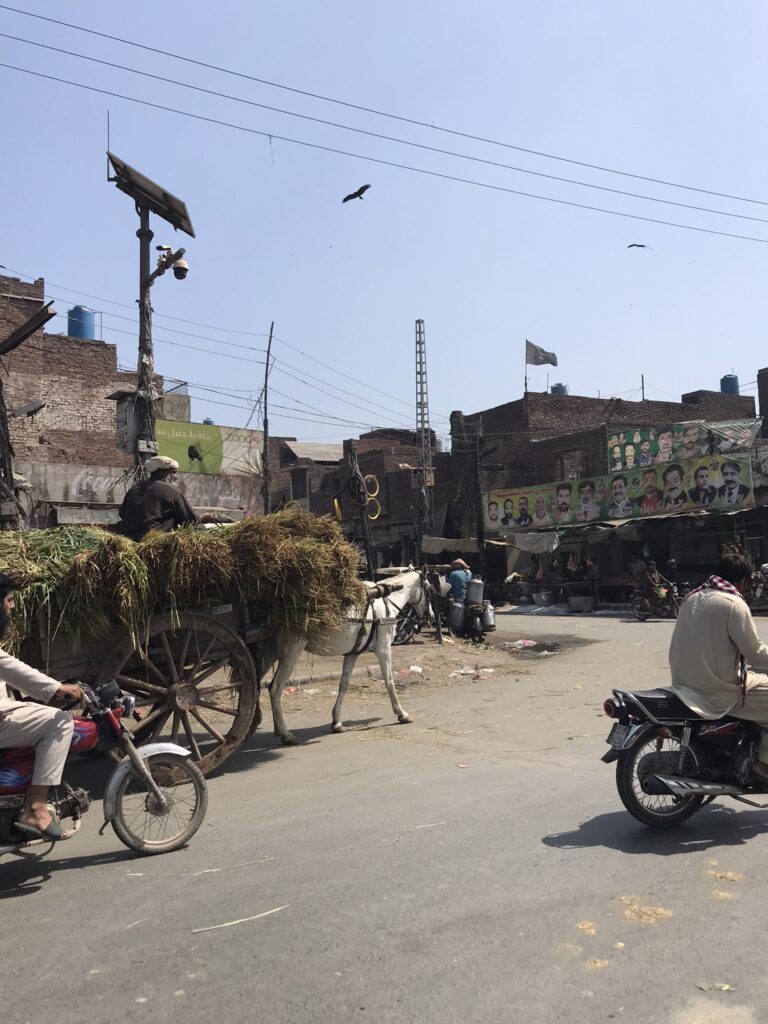
Jahangir and Nur Jahan’s tombs are both in the Shahdara district – easy to reach by metro bus
GPSmycity self-guided walking tour around the Lahore Fort area – Lahore Fort is part of a wider walled complex also including the Gurdwara Dehra Sahib Sri Guru Arjan Dev, Badshahi Mosque and the Tomb of Allama Muhammad Iqbal. Entry to the fort is paid, while the other attractions are free to visit. Entry to all of these attractions can be obtained via Roshnai gate, which is situated at the end of the Lahore Food Street.
Lahore Fort – Lahore Fort has been awarded UNESCO World Heritage status and is one of the major tourist attractions in the city. The fort complex comprises 21 buildings in what used to be the royal Mughal citadel. The Mughal Emperor Akbar is credited with starting the construction. In my opinion the inside of the fort isn’t as impressive as the outside, with plainly decorated royal chambers (Shah Jahan and Jahangir), bare bones public and private audience hall, a royal hammam and the sheesh mahal (palace of mirrors) which costs extra to visit. Craftsmen were in the process of restoring the sheesh mahal when we visited – we happened to meet some of the artisans who invited us to see their work. We noticed that the sheesh mahal has more surviving original decoration than most of the other buildings – probably the reason for the additional entry charge.
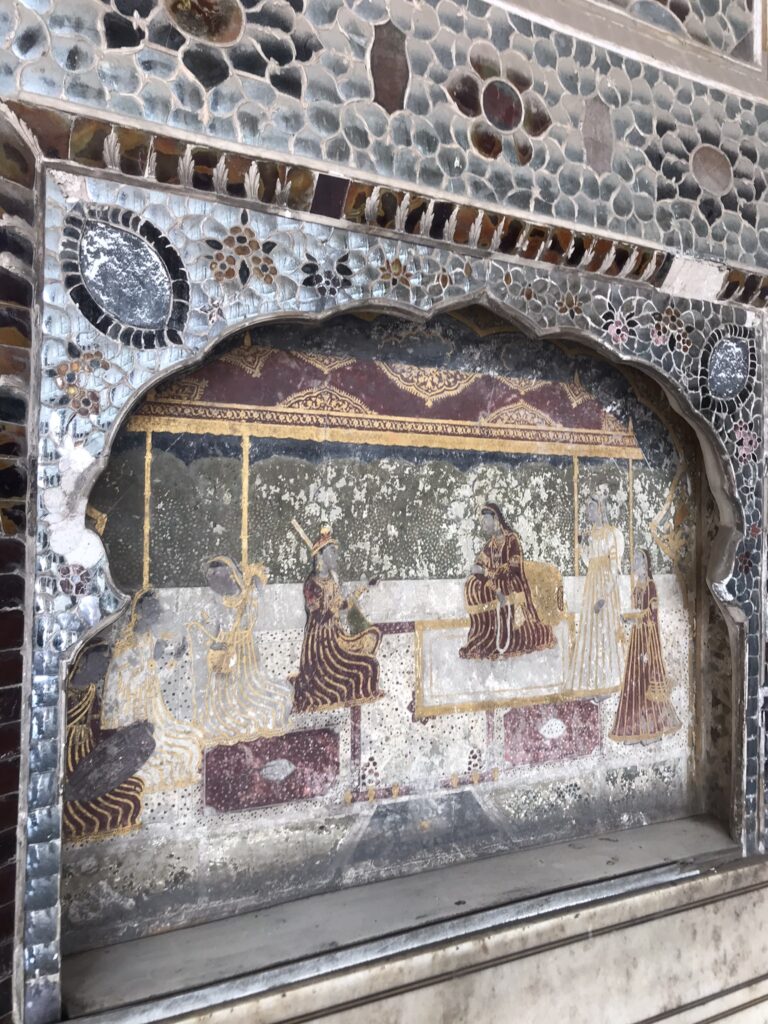
Intricate decoration in the sheesh mahal
There are plenty of information boards scattered around the fort so it’s not necessary to hire a guide at the entrance. The complex is quite large and on especially hot days you can hire a golf buggy with a driver who will take you around and point out the main areas of interest. We saw locals doing this and the price seemed very reasonable, however we weren’t sure if this service was in English or only Punjabi/Urdu.
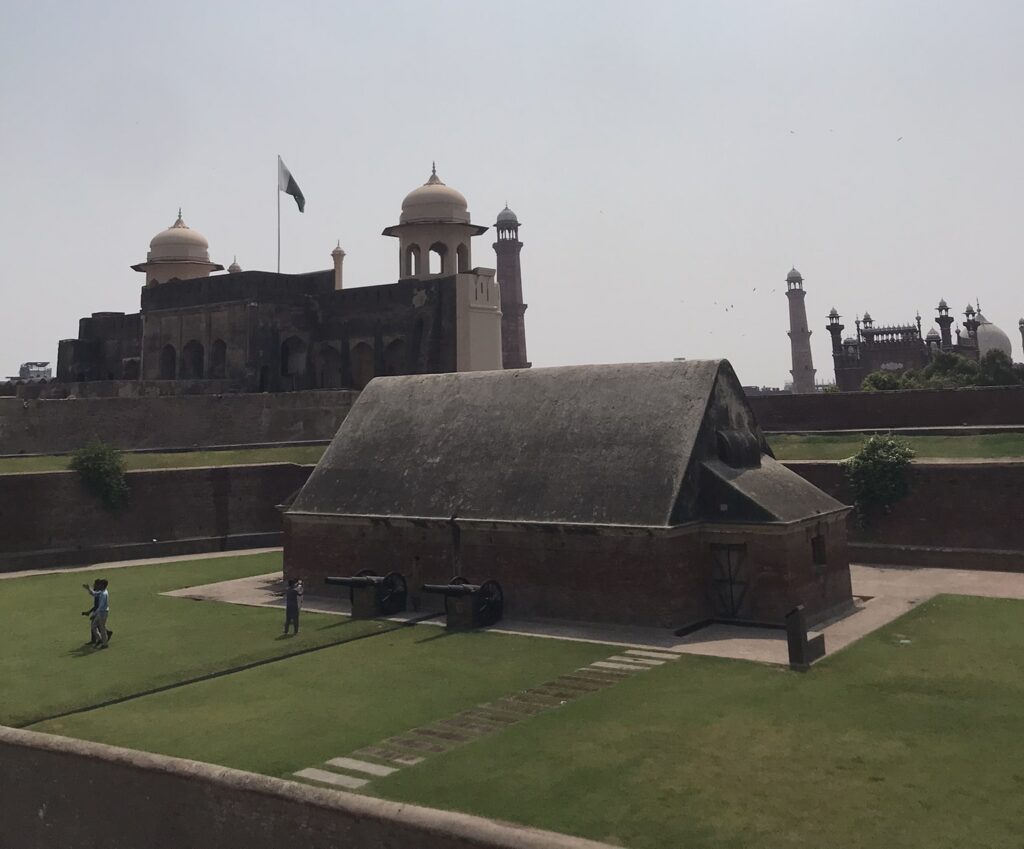
Inside the fort you will find 21 different structures surrounded by manicured lawns and gardens
The pictured tiles which cover the outside of the inner walls of the fort are the highlight of the whole complex, depicting colourful elephant fights, striking polo games and, strangely, floating angels. The Aga Khan foundation is in the process of restoring these picture walls.
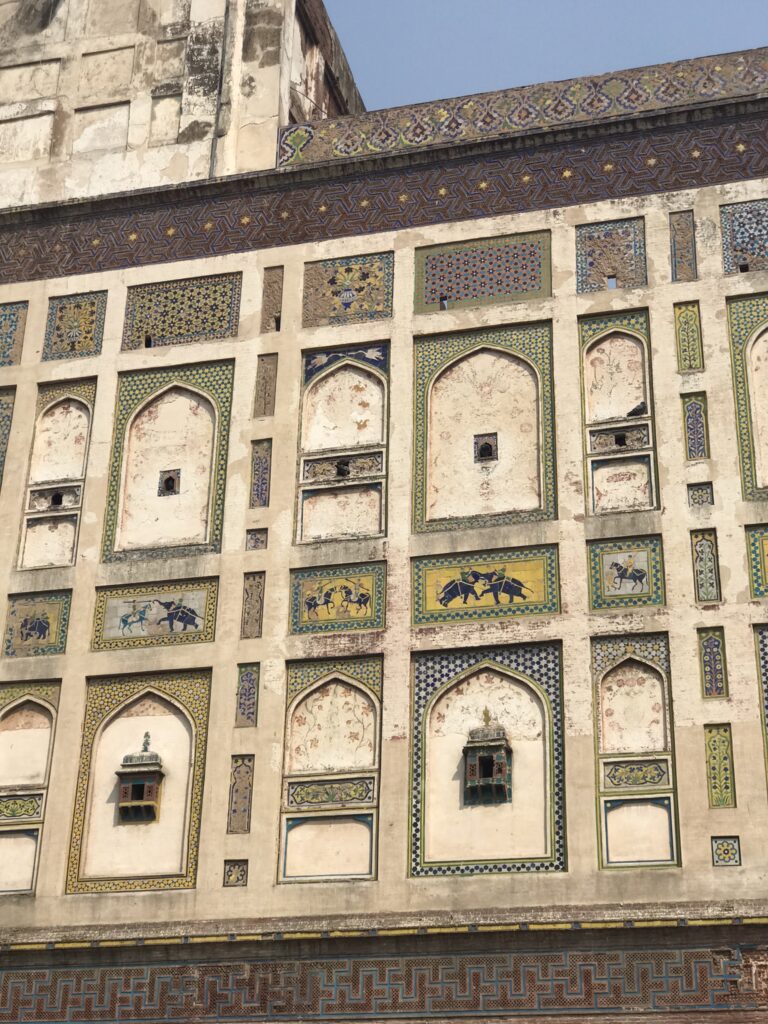
The tile decorations on the external wall are a real highlight, featuring many depictions of fighting elephants
Gurdwara Dehra Sahib Sri Guru Arjan Dev (free entry) – a revered site of pilgrimage for followers of Sikhism due to its historical importance as the site where the 5th Sikh Guru was tortured for 5 days on the orders of the Mughal emperor Jahangir. The 19th century Sikh Maharaja, Ranjit Singh, commissioned the present Gurdwara after conquering Lahore. It now stands as a testament to the fact that the whole Punjab region was once part of the Sikh Empire with Lahore as its capital. The Partition of India in 1947 led to many religious buildings being trapped on one side or the other of the demarcation line. It’s now difficult for Indian Sikhs to visit this gurdwara as cross border travel for Indians and Pakistanis is severely restricted – as a result, Sikhs continue to be separated from their history and culture. Unfortunately the Gurdwara was closed when we tried to visit due to a festival taking place.
Badshahi Mosque (free entry but it’s nice to give a donation – the outside shoe dispensary is slightly expensive so make sure you check the price before using it) – this huge Mughal-era mosque is one of the most iconic sites in the city and in all of Pakistan. For several hundred years it was considered one of the largest mosques in the world and it’s still in the top 20 largest mosques globally, able to accommodate 100,000 worshippers at maximum capacity. It is symbolic of the grand buildings of the Mughal dynasty, crafted of exquisite red sandstone with intricate pietra dura marble inlay work.
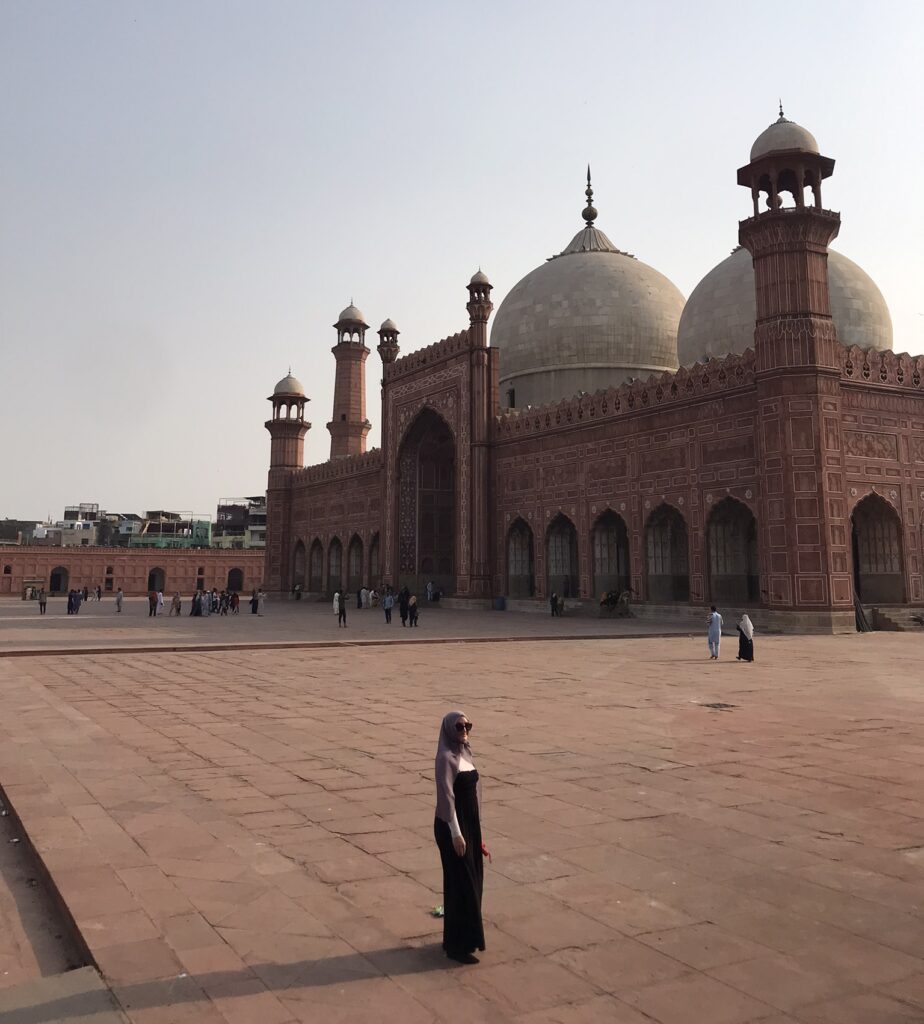
Badshahi Mosque is truly huge
Once you enter the mosque you might be directed to the right to visit a small exhibition containing relics of the prophet Mohammad (PBH). There is also a room dedicated to calligraphy. After having made a small donation you’ll then be pointed into the main courtyard of the mosque. You can explore the chambers surrounding the vast courtyard, but there isn’t much to see in them. The mosque was previously used as a place of worship by the Sikh empire and a military garrison by the British, but little evidence remains of those times. The mosque is particularly stunning at sunset.
Hazuri Bagh gardens (free entry) – as soon as you enter Roshnai Gate you are greeted by these beautiful gardens – very popular with locals as you don’t need to pay any admission fee to visit.
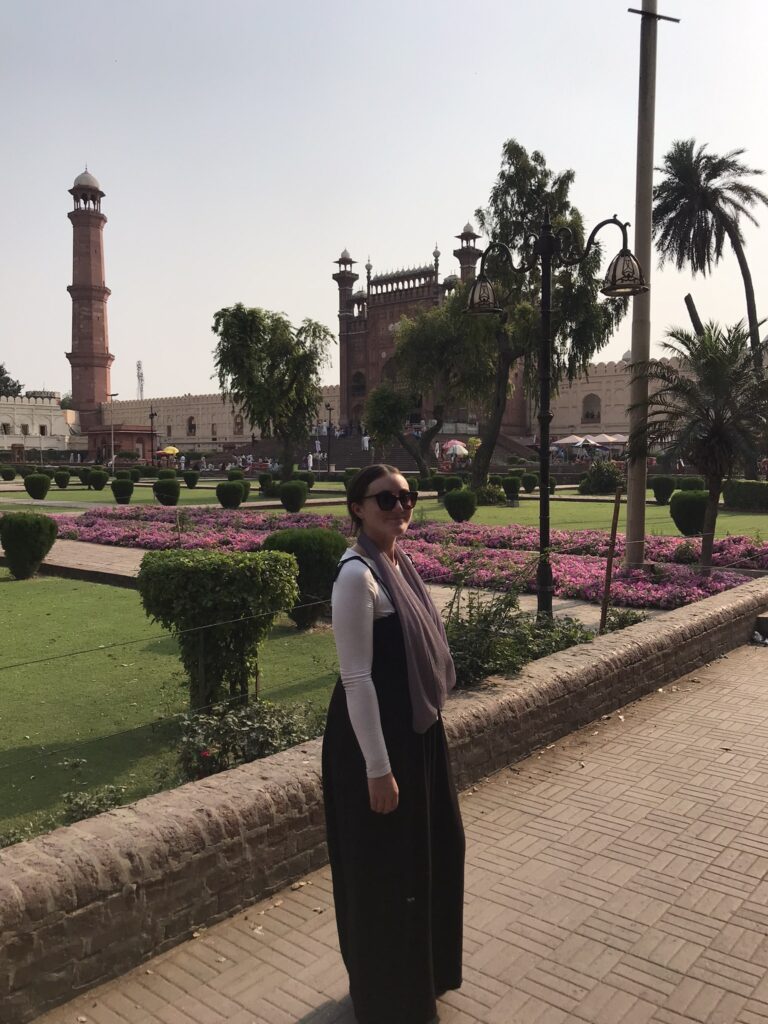
Hazuri Bagh is the central courtyard which is surrounded by Lahore Fort, Badshahi Mosque, the Tomb of Allama Muhammad Iqbal, Roshnai Gate and the Gurdwara
Tomb of Allama Muhammad Iqbal (free entry) – contains the grave of Muhammad Iqbal, the national poet and much revered ‘thinker of Pakistan’. This tomb is guarded by uniformed armed soldiers. You must remove your shoes before entering the miniature mausoleum as a sign of respect.
Minar-e-Pakistan (free entry) – situated in Greater Iqbal Park, this striking monument commemorates the site of the 1940 Lahore Resolution by Jinnah’s All-India Muslim League, which called for an independent nation for Indian Muslims. This later became the guiding principle of Partition in 1947, leading to the creation of the nation of Pakistan. It’s a symbol of the city and Pakistani independence. We read online that it may be possible to ascend to the top of the tower, however it was closed when we were there.
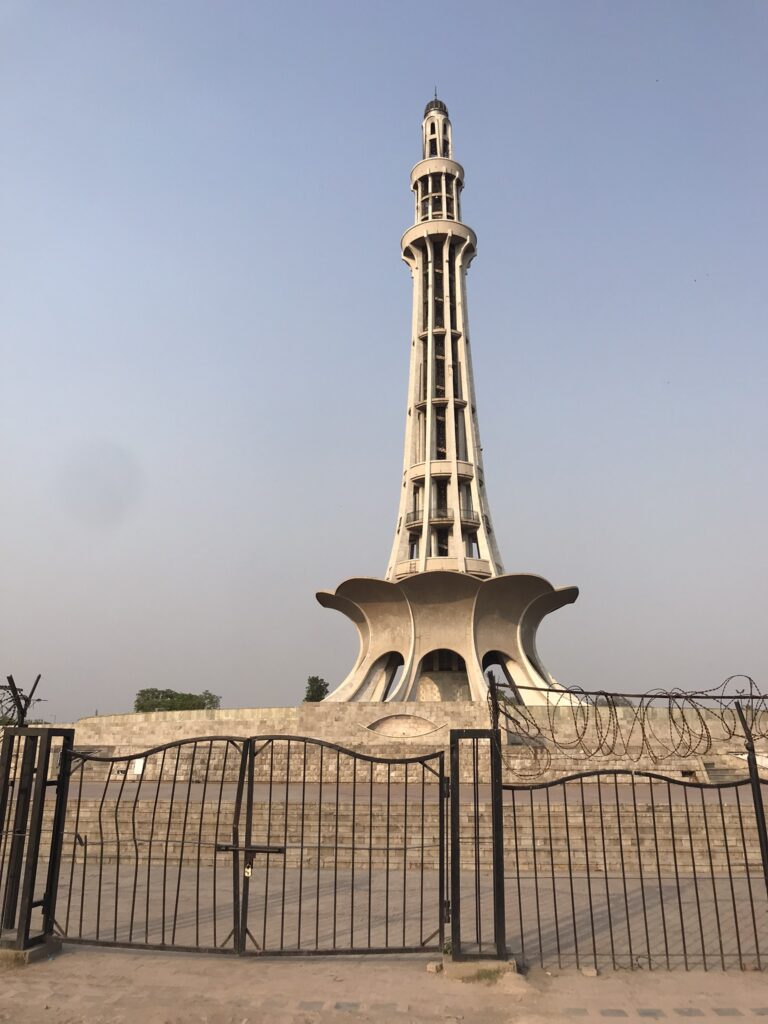
Minar-e-Pakistan is situated within Iqbal Park, but the actual tower was closed when we visited
Lahore Museum – a very extensive museum containing a mix of Islamic artifacts, pre-Islamic Buddhist pieces, some Chinese and miscellaneous world artifacts including part of Berlin Wall, Jain and Sikh exhibits, info about the Harappa/Indus Valley civilizations, Indian miniature paintings, an ‘independence gallery’ containing many photos of Jinnah and his compatriots, a weapons gallery, an ethnographic section with traditional clothing, arts and crafts from various ethnic groups throughout the different regions of Pakistan such as Hunza, Balochistan, Sindh, Chitral and Swat, and small art gallery featuring work from Pakistani artists. We spent several hours in the museum, which is located in a purpose-built British colonial building.
We were intrigued to learn from the museum’s Guest Relations Coordinator that Hinduism may have sprung from the Harappa Civilisation; an ancient seal has been discovered with a depiction of a many-headed god alongside a cow, which some experts believe to resemble the Hindu god Shiva. You can see evidence of this inside the museum, along with some other artefacts from one of the earliest human civilisations on the planet.
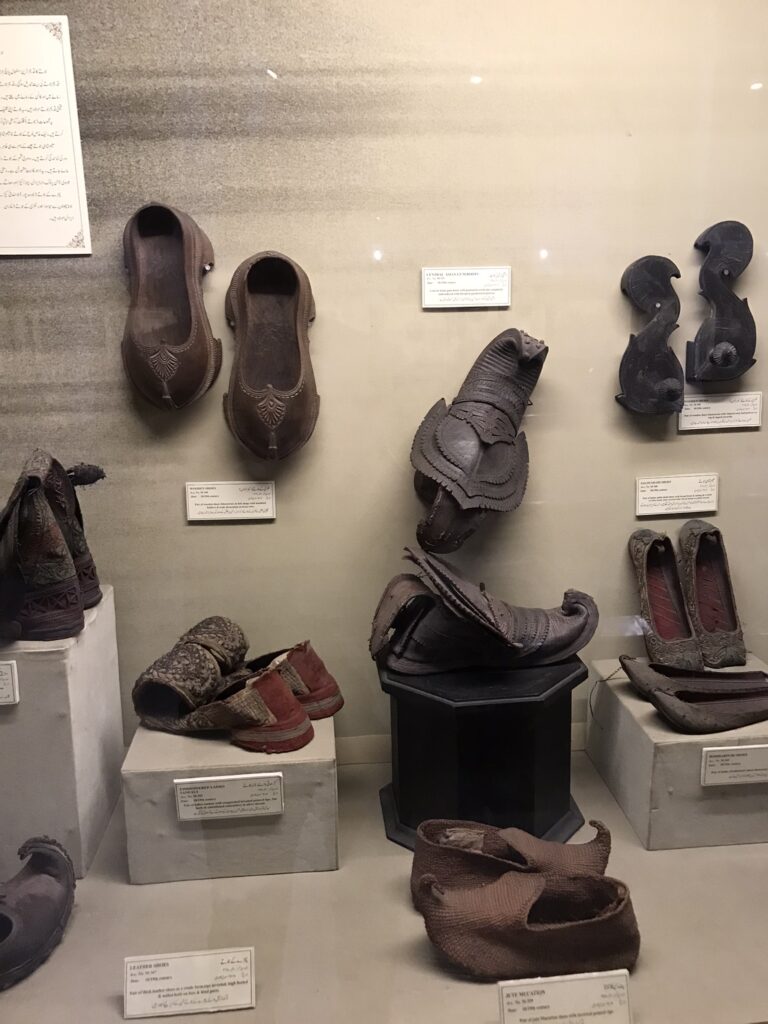
Artwork, artefacts and ethnographic displays can all be found inside the museum
Shalimar Gardens is the other UNESCO World Heritage listed site in Lahore. Unfortunately we didn’t make it inside due to an unexpected closure on the day we visited. I can confirm that it’s very easy to get there using the Lahore metro.
Islamabad
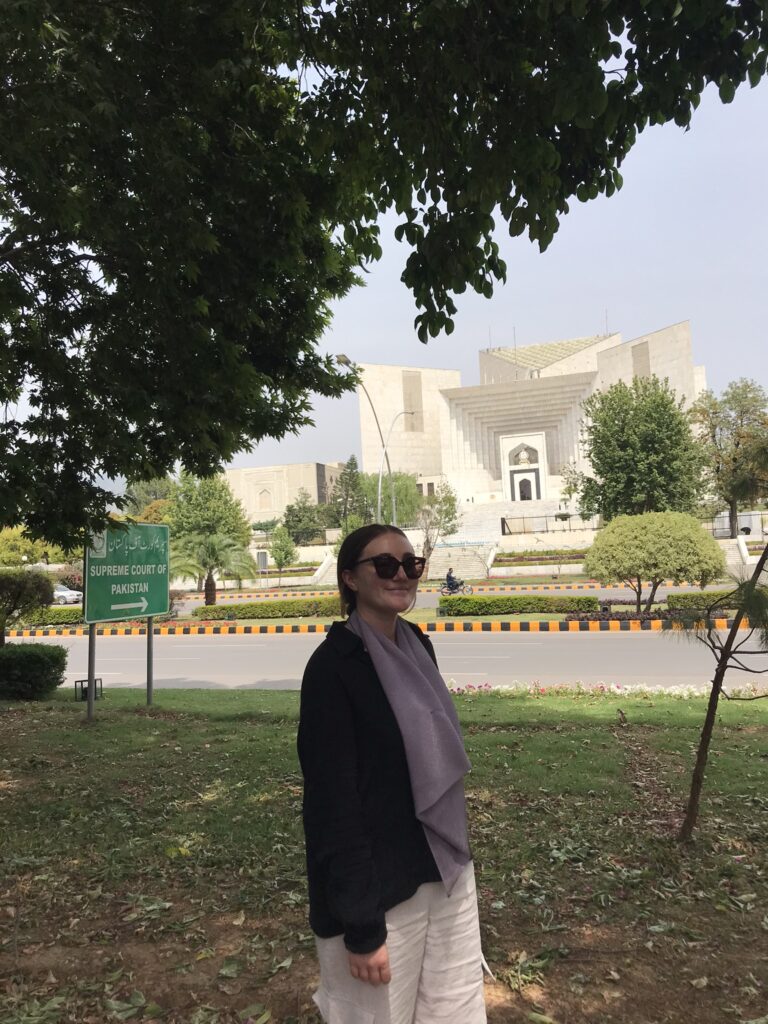
Islamabad is the shiny new capital of Pakistan, created in a bold move to distinguish itself post-independence. The name literally means ‘City of Islam’. It was constructed from scratch in the 1960s, with governance of the country transferred from Karachi to Islamabad in 1967. Due to its relatively new status, it remains only the tenth most populous city in Pakistan, although it forms part of a large urban area alongside its twin city Rawalpindi.
Islamabad stands out as a classic example of modern city planning, with wide boulevards and a sturdy grid layout. Each district is identified by a number and a letter, such as G-9. Because of this, Islamabad has a different feel to other Pakistani cities. The city is very spread out – it’s not actually that big geographically, but because of the spatial dispersion it is not really possible to reach all of the city’s attractions on foot easily. We actually found Islamabad to be a surprisingly desolate place, with lots of large empty lots and spaces. It seemed more like a vision of a ‘city of the future’ from the 1960s, as opposed to a flashy modern capital city like Astana in Kazakhstan.
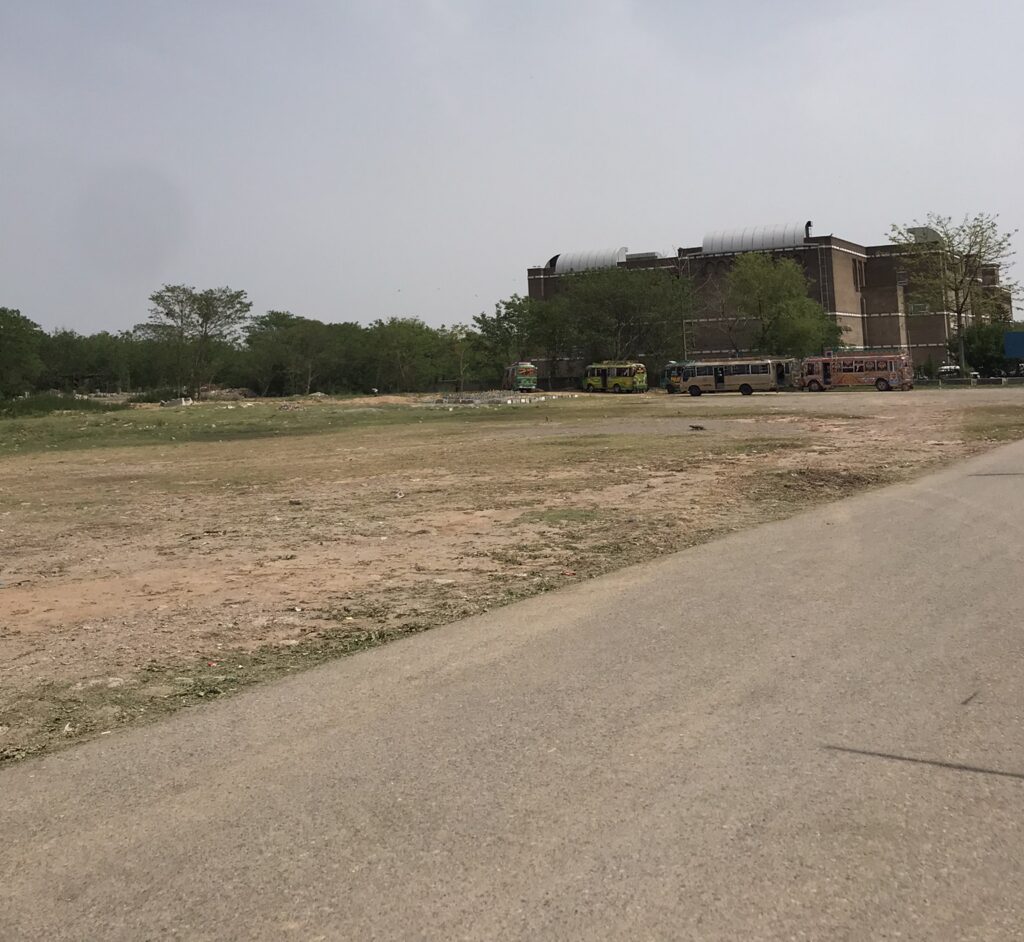
We found that these type of large empty lots were surprisingly common in Islamabad
Islamabad is situated around 300 kilometers from Lahore in the Punjab region, although it is technically not part of Punjab but is its own ‘federal territory’, Islamabad Capital Territory, which also borders the state of Khyber Pakhtunkhwa. Surrounded by the Margalla Hills, Islamabad has a more temperate climate than Lahore and other low-lying cities in the north. While it was 38 degrees celsius when we left Lahore, there was a torrential hailstorm just after we arrived in Islamabad – a local guy we met in a coffee shop showed us evidence of hailstones so big that they had caused damage to parked cars!
The ‘Red Zone’ at the far east end of Islamabad contains the nucleus of government (judicial, fiscal and legislative) with the High Court, Parliament Lodges, President and Prime Minister’s Official Residence and Parliament all located on the same street. This is technically a restricted area and there appeared to be police conducting vehicle searches at the checkpoint entrances to the zone. We entered on foot and were not stopped or checked at all, we were able to walk around freely and see all of the main government buildings (a favourite of ours when visiting a national capital, although in this case we decided that it was probably not a good idea to linger for too long or get too close).
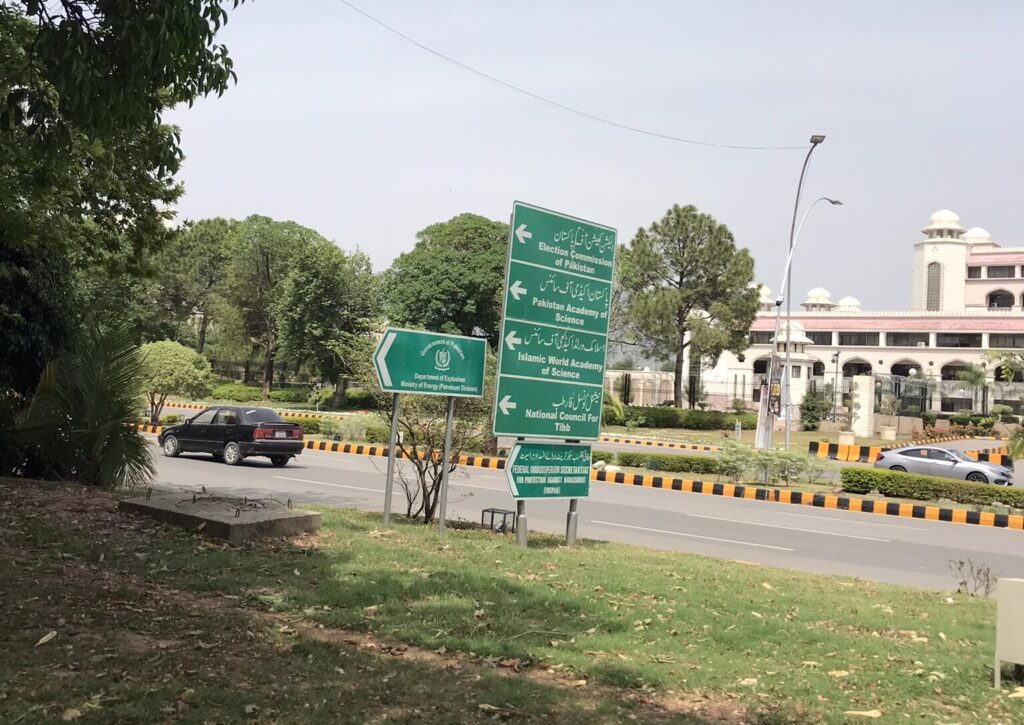
All manner of federal buildings can be found in the Red Zone
We couldn’t help but notice the amount of flashy cars sitting on the driveways of opulent mansions and the lack of ordinary people milling about on the streets near to the Red Zone.
Rawalpindi is the ‘ugly twin’ of Islamabad. Rawalpindi is everything Islamabad is not: a much older settlement, congested, overcrowded and polluted. For a more authentic Pakistani city experience, Rawalpindi could be an interesting place to spend a bit of time. The metro bus system links Islamabad and Rawalpindi, so they really are twins. Sadly we only had one full day in Islamabad before flying out so didn’t have time to explore Rawalpindi.
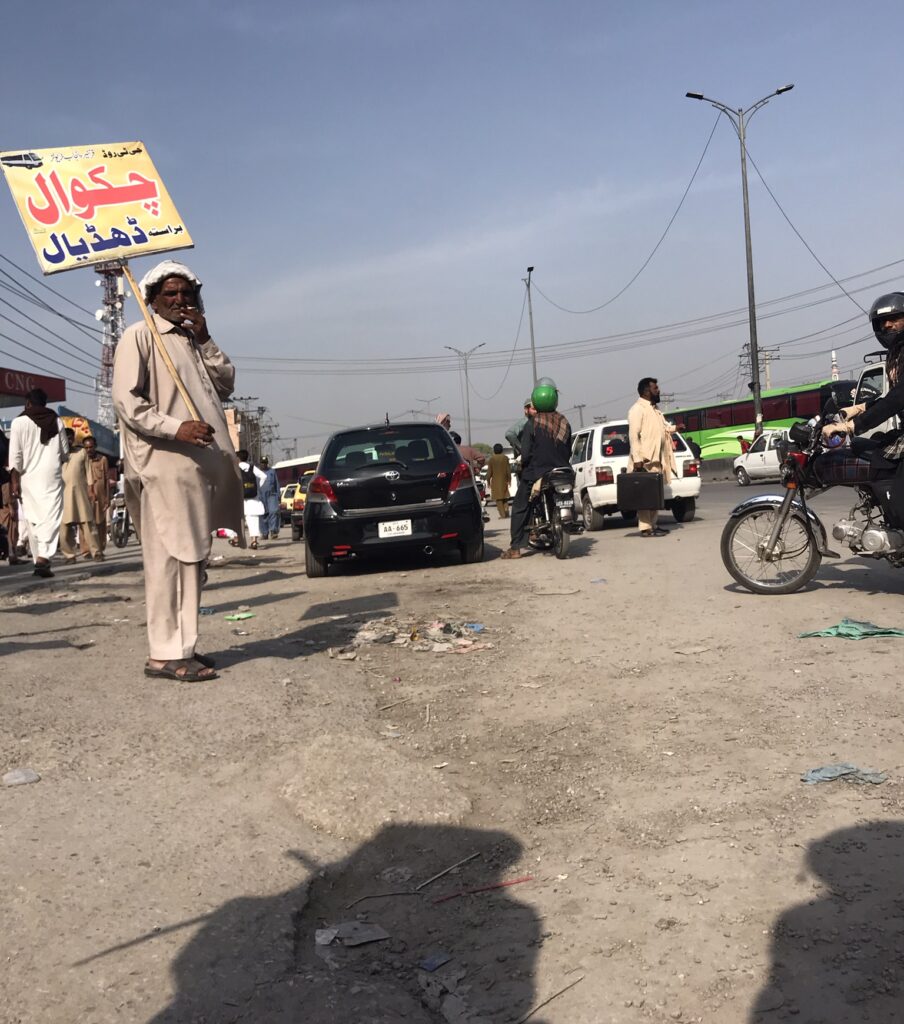
Street scenes in Rawalpindi near Faizabad bus station
When traveling to Islamabad via intercity bus from elsewhere in Pakistan, you’re likely to be dropped off at the Faizabad bus station. This is an overly chaotic area at the boundary between Islamabad and Rawalpindi. From Faizabad, it’s easy to get right to the heart of Islamabad using the metro bus system, which is similar to that in Lahore. The metro bus network in Islamabad/Rawalpindi is more extensive than Lahore, running right from the Red Zone through to the south of Rawalpindi. There is even an airport extension to the metro bus system, although I recommend just using InDrive to get to the airport as it’s likely to be much faster and easier.

Women and children first on the Islamabad/Rawalpindi metro bus
Accommodation
‘Rest house’ accommodation is quite popular in Islamabad as it’s both affordable and comfortable. Essentially this is a private house that has been turned into accommodation, as opposed to a commercial purpose-built hotel.
Holidazzle Lodge Islamabad – we had a peculiar experience here. At first, we had trouble checking in as we turned up to find no one home and nobody responding to our WhatsApp messages. A young lad arrived and showed us to our room and took payment. On the first morning we didn’t receive any breakfast – after a tentative message to the guy which he didn’t respond to, we accepted that breakfast wasn’t going to happen even though it was included in the price. The lad later apologised for this and said he would get us breakfast the next day, only for him to be late the next day with our breakfast as well. When we did receive breakfast it wasn’t great either. We figured that the usual owner/manager was away and had maybe left a helper in charge. All this aside, the rooms were clean and comfortable and the whole house seemed very quiet, eerily so at points for which we were eternally thankful as we needed the rest. Another perk is that there are kitchen facilities available for guests to use.
Foodie Places
Cafe SOIR – attached to the adjacent boutique hotel Sintra, this cafe serves a few decent meal options such as burgers and alfredo pasta, alongside a variety of tasty sweet treats and countless hot and cold drink options. If you’re staying nearby it’s your best bet for trustworthy food.
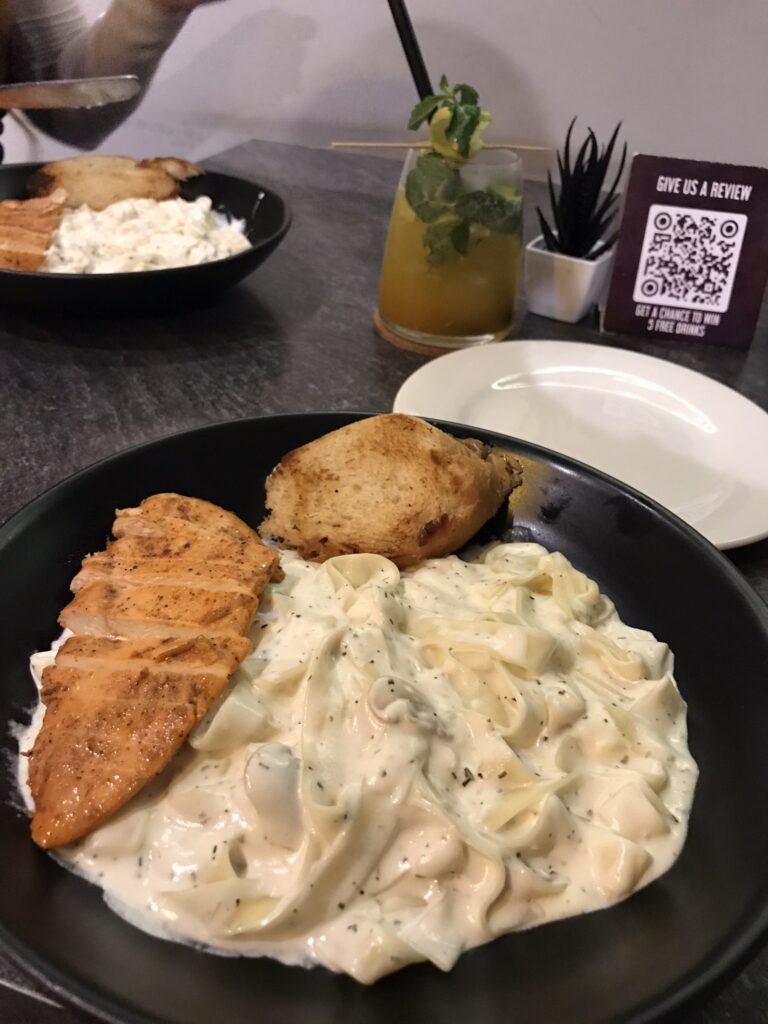
Chicken alfredo pasta at Cafe SOIR – a great choice if you fancy decent Western food
Second Cup Coffee Company – a stylish cafe in an upper-class area of the city. As well as serving a mighty fine cup of coffee you can also find smoothies, milkshakes and flavoured lemonade on the menu. They also have an impressive selection of sandwiches, burgers and main courses to satisfy even the fussiest of eaters. Prices are a little higher but the quality is there. It seems to be a meeting place for young rich socialites. We even spotted a few ladies wearing tight clothing and short-sleeved t-shirts. There are quite a few similar trendy coffee shops in the nearby area.
Activities
We focused our limited time in Islamabad on the Red Zone and nearby attractions, as they were all within walking distance of our accommodation.
Islamabad Museum – a compact museum tracing the history of Pakistan from the Harappa Civilisation in the Indus Valley to the advent of Buddhism and introduction of Islam. Located near to the Red Zone, the museum is free to visit. It’s not the largest or best museum in the country or even the city but is modern, neatly-presented and a great place to start for any budding historians. Be aware that it does close briefly on a Friday afternoon for prayers.